| The best gutters for heavy rain are 6-inch seamless K-style gutters in heavy-gauge aluminum, paired with 3x4-inch downspouts placed every 30 to 40 feet and discharge extensions carrying water 4 to 6 feet from the foundation. Proper sizing depends on roof area, pitch, and peak local rainfall intensity, with 6-inch gutters carrying roughly 40% more water than standard 5-inch systems and micro-mesh guards recommended for tree-covered homes. |
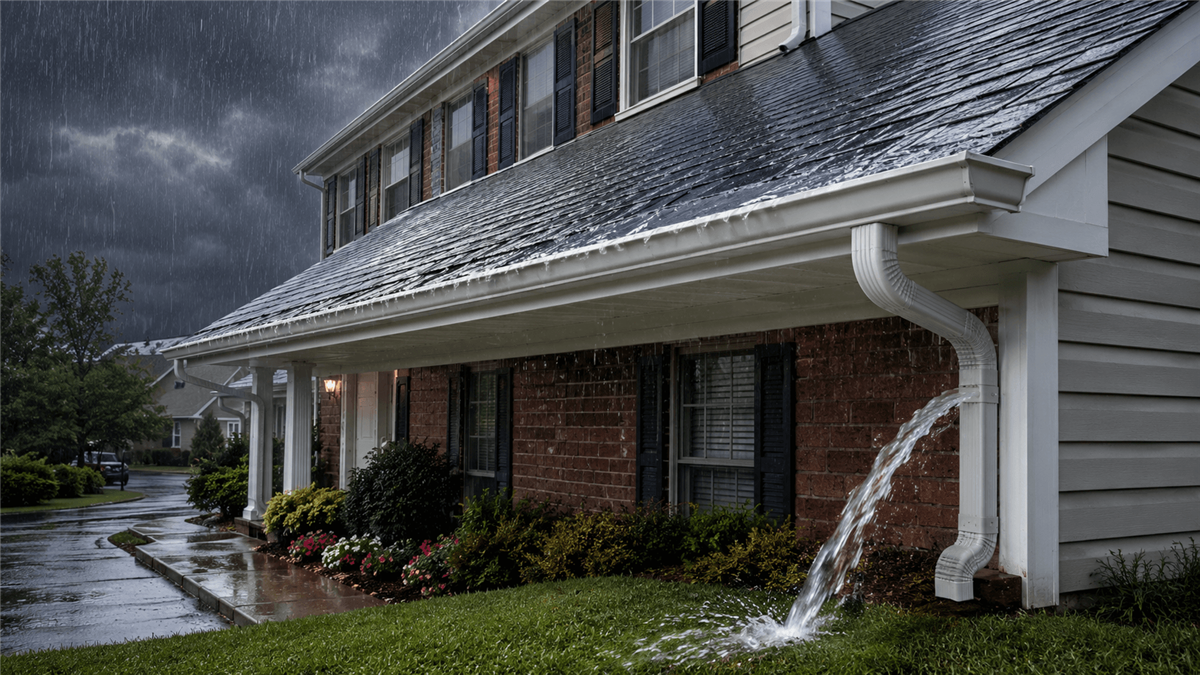
Watch your gutters during the next serious downpour. If water is sheeting over the edges, pooling near your foundation, or running behind the fascia, your system can't keep up. And every storm after that quietly damages your home's structure. Most homeowners only discover their gutters are undersized after the repair bills arrive.
Here's the good news: picking the best gutters for heavy rain comes down to a few measurable factors. Gutter size, material, profile, downspout placement, and pitch decide whether your system handles a storm or gets overwhelmed by it. A 6-inch gutter, for example, can carry roughly 40% more water than a standard 5-inch one, which matters a lot in high-rainfall regions.
This guide breaks down each factor, compares your options side by side, and shows you how to size a system for your roof and local rainfall. Let's get started.
Why Standard Gutters Fail When Storms Hit Hard
Most homes in our region came with standard 5-inch gutters, and for typical rainfall they do the job without complaint. The trouble starts during peak storm events, when an inch or more of rain drops in under an hour. That's the moment a system that looked fine on paper starts dumping water exactly where you don't want it, and it's why homeowners searching for the best gutters for heavy rain usually discover their real problem is capacity, not quality.
How Gutter Systems Handle Water Volume
Picture your gutters as a drainage channel with a fixed ceiling on how much water they can move. Rain runs off your roof, collects in the trough, flows toward the downspouts, and exits away from your foundation. Every step in that chain has a limit, and the entire system performs only as well as its weakest link.
Three factors decide whether your gutters keep up: the roof area draining into each gutter run, your roof pitch, and how hard the rain falls at its peak. Steeper roofs speed up runoff, so water reaches the gutter faster and in bigger surges than the same storm would produce on a low-slope roof. A steep two-story colonial can overwhelm a 5-inch gutter while the rambler next door, with the exact same footprint, stays perfectly dry.
| Gutters aren't sized for average rainfall. They're sized for the worst 20 minutes of the worst storm of the year, because that's when the damage happens. |
Signs Your Current Gutters Can't Keep Up
You don't have to wait for a flooded basement to confirm something's wrong. Your home gives you plenty of warnings first. Here are the signs to watch for during and after heavy rain:
- Water sheeting over the front edge of the gutter: the trough is filling faster than the downspouts can drain it, a classic capacity problem.
- Erosion channels or washed-out mulch below your roofline: a telltale sign of chronic overflow hitting the same spot storm after storm.
- Water stains or peeling paint on fascia boards: water is backing up and running behind the gutter instead of through it.
- Pooling near the foundation or damp basement walls after storms: often the most expensive symptom to ignore, since foundation repairs dwarf the cost of new gutters.
Spotting even one of these means your system is undersized for the storms it actually faces. The fix almost always comes down to capacity, and that starts with understanding what separates the best gutters for heavy rain from the standard ones hanging on most houses.
What Makes the Best Gutters for Heavy Rain
Six factors decide whether a gutter system rides out a downpour or overflows within the first ten minutes. When they work together, the whole setup performs as one unit. When even one is wrong, the rest can't make up the difference. If you're shopping for the best gutters for heavy rain, these are the details worth getting right the first time.
Gutter Size and Capacity: 5-Inch vs. 6-Inch
Size is the first lever to pull. A 5-inch K-style gutter is the residential default, and it handles moderate rain on smaller roofs without complaint. But factor in a steep roof pitch (which sheds water faster) or a large roof plane feeding a single run, and that extra inch of width starts earning its keep.
The upgrade cost is modest, usually a small premium per linear foot, while the capacity gain is substantial. For homes with roof sections over 1,400 square feet draining to one gutter run, or roofs pitched above 6:12, a 6-inch gutter is the safer call. Some contractors go further and install 7-inch gutters on commercial buildings and homes with metal roofs, since metal sheds water almost instantly instead of absorbing any of it.
Gutter Materials Compared: Aluminum, Steel, and Copper
Material affects durability, weight capacity, and how the gutter behaves while holding a full load of water mid-storm. A gutter full of water is heavy, roughly 8 pounds per gallon, so the material and hanger spacing have to carry that weight without sagging.
The table below compares the three main gutter materials and how each one performs when the rain gets serious:
Gutter Material Comparison for Heavy Rain
| Material | Typical Lifespan | Strength Under Load | Best For |
| Aluminum | 20+ years | Good with tight hanger spacing | Most homes; best value, rust-proof |
| Galvanized/Galvalume Steel | 15 to 25 years | Excellent, resists dents and ladder damage | Homes with heavy snow, ice, or tree debris |
| Copper | 50+ years | Excellent | Historic or high-end homes; premium budgets |
For most households, heavier-gauge aluminum (0.032 inches rather than the thinner 0.027) hits the sweet spot: it won't rust, it holds paint well, and it stands up to a waterlogged run without deforming.
Seamless vs. Sectional Gutters
Sectional gutters arrive in pre-cut lengths joined with seams every 10 feet or so. Each seam is a future leak point, and heavy rain finds them fast. Water pressure pushes against every joint, sealant breaks down through freeze-thaw cycles, and debris snags on the ridges where sections meet.
Seamless gutters are roll-formed on-site from a continuous coil, so the only joints sit at corners and downspout outlets. Fewer joints means fewer leaks, smoother water flow, and less maintenance over the life of the system. For storm-prone regions, seamless is the standard recommendation, which is why most professional installers won't quote sectional systems anymore.
| Every seam in a gutter run is a leak waiting for its first hard freeze. Seamless gutters remove the weakest link before it exists. |
Gutter Profiles: K-Style vs. Half-Round
Profile shape changes capacity more than most homeowners realize. K-style gutters have a flat back and a decorative front that resembles crown molding, and their squared-off trough holds more water than a half-round gutter of the same width. That extra volume is exactly what you want when rain is hammering down.
Half-round gutters drain and self-clean beautifully because debris doesn't cling to their curved interior, but they carry less water inch for inch. They're a solid pick for historic homes where appearance drives the decision. When raw storm capacity is the priority, K-style wins, and pairing a 6-inch K-style profile with oversized downspouts gives you one of the highest-capacity residential setups available.
Downspouts, Pitch, and Drainage Design
Here's the part that gets overlooked: gutters don't drain themselves, downspouts do. An oversized gutter feeding an undersized downspout still overflows. Standard 2x3-inch downspouts choke on heavy flow, so upgrading to 3x4-inch downspouts nearly doubles the exit capacity of each drop. A good rule of thumb is one downspout for every 30 to 40 feet of gutter run.
Pitch matters too. Gutters should slope roughly a quarter inch for every 10 feet of run toward the downspout. Too flat and water sits, breeding corrosion and mosquitoes. Too steep and water races past outlets during hard rain. Finally, extensions or buried drain lines should carry discharge at least 4 to 6 feet away from the foundation. Skip that step and you've simply relocated the flooding problem to your basement wall.
Gutter Guards for Storm-Prone Homes
A clogged gutter performs like no gutter at all, so guards deserve serious consideration if your property has overhanging trees. Micro-mesh stainless steel guards block shingle grit, pine needles, and leaves while letting high volumes of water pass through. Cheaper foam inserts and snap-in screens tend to restrict flow or blow loose in storms, which defeats the purpose.
One honest caveat: during extreme cloudbursts, water can sheet over some guard designs, especially on steep roofs. Quality micro-mesh systems installed at the correct angle keep this to a minimum, but no guard eliminates maintenance entirely. Think of guards as cutting your cleanings from four times a year down to a quick annual inspection.
How to Choose the Right Gutter System for Your Home
Once you understand what each component does, the next question is how to combine them for your specific house. Two homes on the same street can need completely different setups depending on roof size, pitch, and tree cover. Working through the decision methodically beats guessing every time, especially if you're shopping for the best gutters for heavy rain.
Step-by-Step: Sizing Gutters for Your Roof and Rainfall
Sizing a gutter system comes down to simple math paired with a little local knowledge. Here are the steps to complete before you request a single quote:
- Measure your drainage area. Calculate the square footage of each roof plane that feeds into a single gutter run. Use length times width per section rather than the whole roof at once, since each run only handles what drains into it.
- Factor in roof pitch. Steeper roofs shed water faster, so multiply your drainage area by a pitch factor. A roof at 6:12 or steeper effectively increases the load on your gutters by 10 to 20 percent compared to a low-slope roof of the same size.
- Check local peak rainfall intensity. Gutter sizing charts rely on maximum rainfall per hour, not annual averages. The DMV sees intense summer thunderstorms, so plan for cloudbursts rather than gentle drizzle.
- Match capacity to load. If any single run drains more than roughly 1,400 square feet of adjusted roof area, step up to 6-inch gutters with 3x4-inch downspouts.
- Map downspout locations. Confirm you have one drop per 30 to 40 feet of run and that each discharge point carries water well clear of the foundation.
Run this exercise before contractors arrive and you'll immediately spot the difference between a quote built for your roof and a one-size-fits-all bid. Anyone selling the best gutters for heavy rain should be doing this same math, and if they skip it, that tells you something.
Budget vs. Long-Term Value: What to Weigh
Price per linear foot is the number everyone fixates on, but it hides the real cost picture. A bargain sectional aluminum system might save you a few hundred dollars today, then hand that savings back through resealed joints, sagging runs, and an early replacement. The cheapest bid often ends up being the most expensive gutter you'll ever own.
| Compare quotes on cost per year of reliable service rather than install price alone. A system that lasts twice as long at a 30 percent premium wins that comparison every time. |
A practical way to weigh your options: take each quote, estimate the system's realistic lifespan, and add expected maintenance like joint resealing or guard replacement. Heavier-gauge seamless aluminum with quality hangers usually lands in the middle on upfront cost and comes out ahead on total ownership. Copper only makes financial sense if you plan to stay in the home for decades or the architecture demands it. Whatever material you pick, skimping on downspout upgrades to save $150 is the one cut that undermines everything else you paid for.
Installing the Best Gutters for Heavy Rain in the DMV
Everything covered so far, sizing, materials, downspouts, only matters if the system is matched to your local weather and installed correctly. In Northern Virginia, Maryland, and Washington, D.C., that means planning for a very particular kind of rain.
Why Local Rainfall Patterns Should Shape Your Choice
DMV storms rarely spread rain out evenly. Summer thunderstorms unload intense bursts in short windows, while the remnants of tropical systems can stall over the region and soak it for hours. The best gutters for heavy rain in this area have to handle both the cloudburst and the marathon, which is why capacity margins that look generous elsewhere are simply practical here.
Winter adds another test. Freeze-thaw cycles stress sealed joints and work hangers loose, so seam count and fastener quality carry more weight here than in milder climates. Factor in the mature oaks and maples common in older neighborhoods around Arlington, Fairfax, and Bethesda, and debris management becomes part of the storm equation too.
| In the DMV, a gutter system has to handle a July cloudburst, a September tropical soaker, and a January freeze, all with the same hardware. |
The table below shows how a typical builder-grade setup stacks up against a configuration built for this region's weather:
Standard vs. Storm-Ready Gutter Setup for DMV Homes
| Component | Builder-Grade Setup | Storm-Ready Setup |
| Gutter | 5-inch sectional, thin-gauge | 6-inch seamless, heavy-gauge aluminum |
| Downspouts | 2x3-inch, sparsely placed | 3x4-inch, one per 30 to 40 feet |
| Discharge | Short splash blocks | Extensions or buried drains, 4 to 6 feet out |
| Debris control | None | Micro-mesh guards on tree-covered runs |
How NV Roofing's Residential Services Protect Your Home
This is where a local team earns its keep. NV Roofing has served the DMV since 1963, and that experience shapes how our Residential Services handle gutters: we size runs to your actual roof planes and pitch, roll seamless gutters on-site so they fit your home exactly, and pair them with guards wherever the trees demand it.
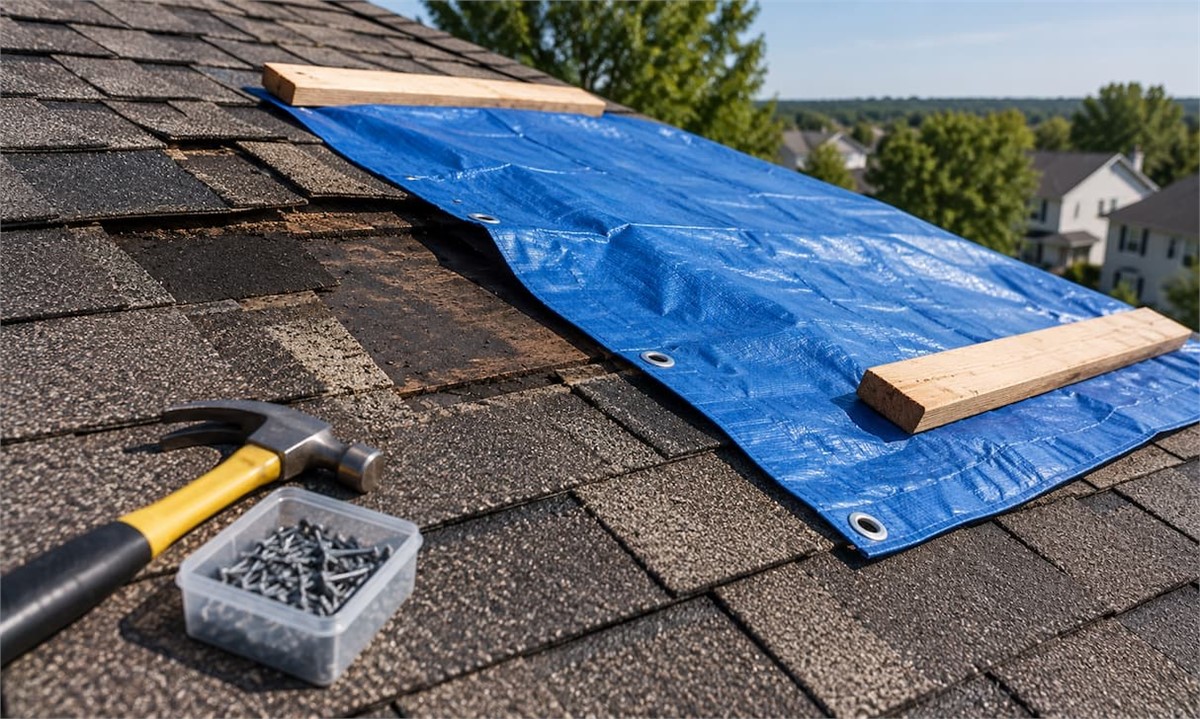
Gutters, roofing, and siding all share the same water-management job, so we evaluate the whole exterior instead of treating one piece in isolation. If storm damage is what brought you here, our crews also handle inspections, emergency tarping, and insurance claim support, which means you avoid coordinating three separate contractors after a rough night of weather.
Ready to find out what your home actually needs before the next downpour? Contact us for a straightforward assessment and quote.
Conclusion
Here's what makes gutters different from most home projects: the numbers actually predict the outcome. Nail the width, put in enough downspouts, and carry the discharge far enough from the house, and your foundation stays dry while the neighbor's basement takes on water. Miss those specs, and no cleaning schedule or tube of sealant will fix it. The best gutters for heavy rain are decided in inches, once, on installation day, and that decision does the work for decades.
So here's your homework. Wait for the next serious downpour and just watch. Water sheeting over the corners, splashing hard at the downspouts, or pooling under the roofline will show you exactly where the system falls short. Take those notes, plus your roof measurements, to a contractor and ask them to walk you through their sizing math. Anyone who can't explain why a particular setup fits your house isn't the right person for the job. Keep looking until someone can.
FAQs
What are the best gutters for heavy rain?
A 6-inch seamless K-style gutter in heavy-gauge aluminum, paired with 3x4-inch downspouts, is widely considered the best setup for heavy rain. This combination maximizes both holding capacity and drainage speed, which is where most standard systems fall short.
Is a 5-inch or 6-inch gutter better for heavy rainfall?
A 6-inch gutter is the better choice for heavy rainfall because it moves significantly more water than a 5-inch model for only a small increase in cost. It becomes essential on steep roofs or large roof planes where runoff arrives fast and all at once.
Are seamless gutters really better than sectional ones?
Yes, because seamless gutters have joints only at corners and outlets, eliminating the dozens of seams where sectional systems typically leak and fail. In storm-prone areas, that reliability difference shows up quickly during hard downpours and freeze-thaw winters.
Which gutter material lasts the longest?
Copper is the longevity champion, often lasting 50 years or more, while quality aluminum typically delivers two decades or better with minimal upkeep. For most budgets, heavier-gauge aluminum offers the best balance of lifespan, strength, and price.
Do gutter guards work during heavy rain?
High-quality micro-mesh guards allow large volumes of water through while blocking leaves and debris, making them a smart addition to the best gutters for heavy rain on tree-covered properties. Cheaper foam or screen guards can restrict flow, so the guard type matters as much as the gutter itself.
Subscribe to NV Roofing's Blog