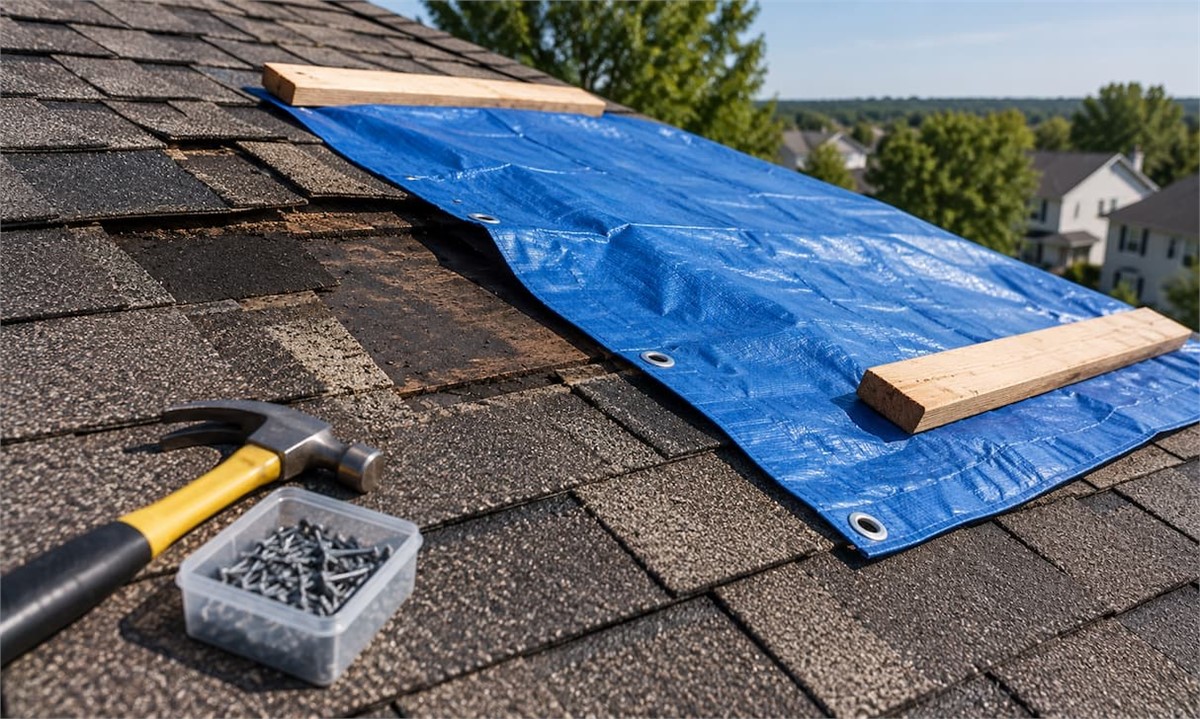
TL;DR: A temporary fix for missing shingles means tarping over the ridge with battened edges, slotting in a replacement shingle with roofing nails and cement, or sealing small gaps with peel-and-stick membrane, which buys anywhere from a few days to three months of protection depending on the method. Skip the caulk-and-glue approach since it fails within a storm or two, and move to a permanent repair quickly, because water reaching the decking turns a minor shingle job into rotted sheathing, attic mold, and interior damage. |
You step outside after a windy night in Northern Virginia and see it immediately: a bare patch on your roof, and maybe the shingle itself sitting in your driveway. A missing shingle exposes the wood decking underneath to rain, wind, and pests. Once water soaks that deck, repair costs climb fast, and rot can spread well beyond the original opening.
You do have options. A solid temporary fix for missing shingles can protect your home for days or even weeks while you line up a permanent repair. This guide covers what to do first, which patching methods actually hold through a storm, which ones fail and why, and how to tell whether you're dealing with one loose shingle or a roof that's nearing the end of its life. Practical steps you can act on today, no guesswork required.
Why Missing Shingles Become a Bigger Problem Fast
One shingle. A few square feet of bare spot. It's easy to shrug off, especially when the rest of the roof looks perfectly normal from the driveway. But an asphalt shingle roof is a layered system, and every piece leans on the pieces around it. Pull one tab out of that chain and the whole section starts working against you.
Shingles overlap so water runs downhill and never touches the wood underneath. Each course also hides the nail heads of the course below it. When wind lifts one shingle free, it exposes those nails plus the top edge of the shingle beneath, and that edge was never built to face weather head-on.
That's why the damage almost never stays put. The next gust catches the freshly exposed edge and peels the neighbor loose, then the one after that. Around the DMV, a single spring thunderstorm can turn one bare patch into a whole row of them before sunrise.
Roof decking is the plywood or OSB sheathing beneath your shingles and underlayment. It's structural, absorbent, and never meant to get wet.
Most roofs have underlayment (felt or synthetic) sitting between the shingles and the deck, and it does buy you a little breathing room. Treat it as a backup layer rather than a finish surface. UV exposure chews through felt fast, and wind-driven rain hunts for seams and staple holes.
Once moisture reaches the sheathing, the problems stack up quickly. Here's what a small opening tends to turn into when it's left alone:
- Swelling and delamination: wet OSB puffs up and separates into layers, which means the deck itself has to be cut out and replaced.
- Mold in the attic: damp insulation holds moisture against the framing and spreads the problem well past the original leak point.
- Pests: squirrels and wasps find soft, chewed-up decking long before you do.
- Interior damage: stained ceilings and ruined drywall turn a roof job into a repair that touches two floors of your house.
A repair that would have run a few hundred dollars stops being a shingle job and becomes carpentry. |
In dry weather with the underlayment still intact, a few days is usually survivable. With rain in the forecast, the clock is running, and that's exactly when a temporary fix for missing shingles pays for itself. Check the DMV forecast and make the call: dry week ahead, schedule the repair; storm rolling in, get it covered today.
If you're not comfortable on a ladder or the missing shingles sit above a steep pitch, skip the DIY attempt and call NV Roofing. A proper tarp or patch takes an hour and protects the deck until a permanent repair can be done right.
Temporary Fix for Missing Shingles: What Actually Works
Start With Safety
Falls from residential roofs put a steady stream of people in emergency rooms every year, and most of those accidents happen on ordinary houses, not job sites. Before anything else, ask whether the work can wait for dry, calm conditions. Asphalt shingles turn slick as glass when wet, and they get brittle once temperatures drop toward 40 degrees, which means you can crack three good shingles while trying to save one.
A few non-negotiables: extend your ladder at least three feet above the roof edge and tie it off at the top. Check for overhead service lines before you raise it. Wear soft-soled shoes with real grip, not sneakers. If your roof pitch is steeper than 6:12 (a six inch rise for every twelve inches of run), you're on a surface most people can't walk without a harness and anchor. And if the wind is still gusting, stay on the ground. A tarp acts like a sail, and so does a sheet of plywood.
What You Need for an Emergency Roof Patch
Most of this sits on the shelf at any hardware store in the DMV, and it's worth keeping on hand if you live anywhere the nor'easters reach. Here's what a workable emergency kit looks like:
- A heavy-duty poly tarp: rated at least 6 mil, sized so it covers the damaged area plus three feet of overlap on every side, ideally running all the way over the ridge.
- Furring strips or 1x3 lumber: cut to the tarp width, used to sandwich and anchor the tarp edges instead of relying on grommets and rope alone.
- Asphalt roof cement: meeting ASTM D4586 specs (Henry and Gardner-Gibson both make widely stocked versions), plus a caulk gun and a putty knife.
- Self-adhering flashing tape or peel-and-stick underlayment: the same category of product as ice and water shield, for sealing small gaps directly to the deck.
- Hand tools: a flat pry bar, roofing nails (1¼ inch minimum), a hammer, a utility knife with hook blades, and heavy gloves.
If you have leftover shingles from your last roof, pull them out. Matching color and profile matters less for a patch than having the right thickness and exposure, though a matching bundle makes the eventual permanent repair cleaner.
Option 1: Tarp the Damaged Area
Tarping is the workhorse of emergency roofing, and it's what our crews deploy first on storm calls. It buys weeks, not days, when it's done correctly. Done poorly, it traps water and makes the leak worse.
Follow this sequence to get a tarp that actually stays put:
- Clear loose debris and broken shingle fragments from the area so the tarp lies flat.
- Unroll the tarp so the top edge extends past the ridge of the roof. Water runs downhill, and a tarp that stops below the ridge lets rain slide underneath it.
- Wrap the top edge of the tarp around a furring strip, roll it once or twice, then screw or nail that strip into the roof through the tarp. You're creating a clamped edge instead of a row of tear-prone grommet holes.
- Repeat on the bottom edge and both sides, pulling the tarp taut as you go. Standing water in a sagging tarp will find every fastener hole you made.
- Seal the fastener heads on the uphill strips with a dab of roof cement.
Yes, you're putting holes in the roof. Those holes get repaired properly later, and they do far less damage than a week of rain sitting on bare decking.
Option 2: Slot in a Replacement Shingle
If a single shingle blew off and the surrounding ones are intact, you can slot in a replacement. Pick a mild day when the shingles flex. Gently lift the tabs of the course above the gap and use the flat bar to pop the nails holding the upper shingle's bottom edge, which are often the same nails that were holding the missing one.
Slide the new shingle up into the slot until its bottom edge lines up with its neighbors, then nail it through the nailing strip with four nails, keeping them under the overlapping course. Finish with a bead of roof cement under each lifted tab and press it back down. Don't glob cement over the exposed face of the shingle. It traps moisture, stains the surface, and makes the permanent repair messier.
Option 3: Use Peel-and-Stick Membrane for Small Gaps
When the gap is narrow, say a torn corner or a single exposed sliver of decking, self-adhering flashing tape is faster and cleaner than a tarp. Wipe the deck dry, peel the release film, and press the membrane down so it laps under the shingle course above and over the course below. Roll it firmly with a hand roller or the heel of your palm to activate the adhesive.
The catch: these membranes need a dry surface and temperatures above roughly 40 degrees to bond. On a damp January morning in Maryland, the tape will lift within a day.
Why Caulk and Glue Usually Fail
This is the mistake we see most often. A homeowner finds the blown-off shingle in the yard, smears construction adhesive or silicone caulk on the back, and presses it into place. Two storms later, it's on the ground again.
An asphalt roof is a water-shedding system rather than a waterproof membrane. Each shingle overlaps the one below it so gravity carries water down and off. Adhesive alone can't replicate the nailing pattern and overlap that keep wind from getting underneath.
There's a second issue. Shingles seal themselves with a factory-applied thermal strip that bonds in summer heat. When one shingle lets go, it usually means that sealant strip has failed across a wider area, so the neighbors are next. A shingle stuck down with caulk also can't expand and contract with the deck, and UV exposure breaks most household adhesives down within a season.
Watch Valleys, Flashing, and Penetrations
Where two roof planes meet, water volume concentrates dramatically. A missing shingle three feet from a valley is an annoyance. A missing shingle inside a valley is an emergency, because that channel may be carrying runoff from half your roof.
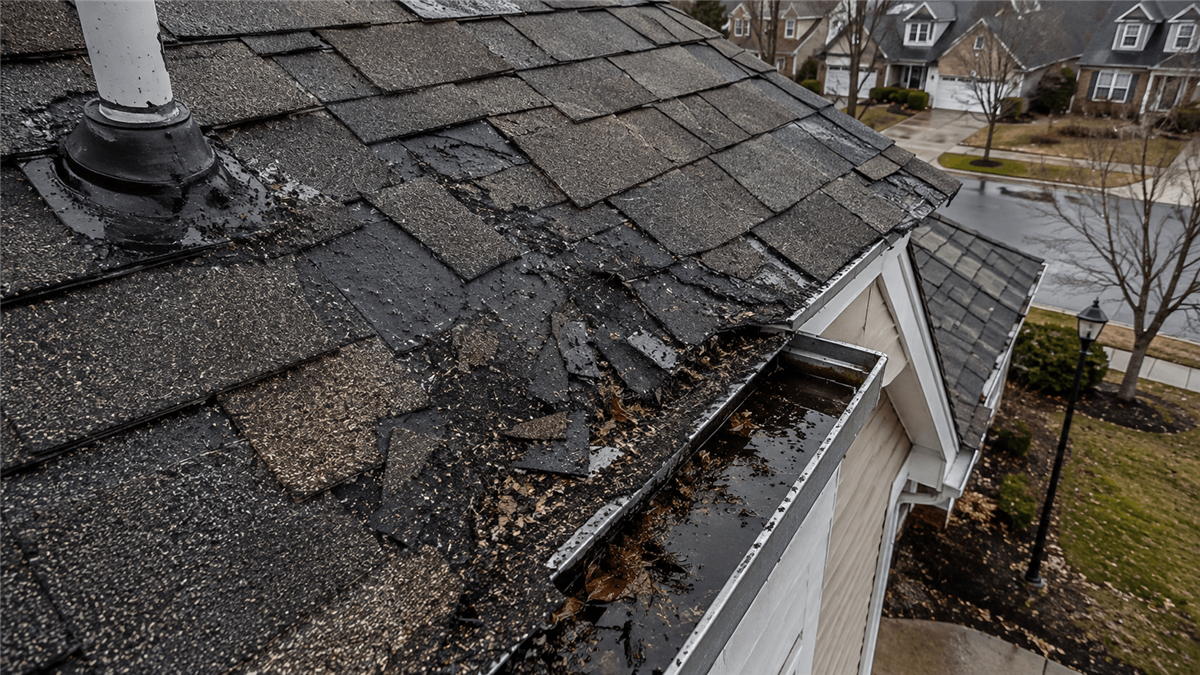
The same goes for anything the shingle was tucked against: step flashing along a dormer wall, counterflashing at the chimney, the collar around a plumbing vent. When wind lifts shingles, it often disturbs those metal pieces too. Look for bent, lifted, or rust-stained flashing while you're up there, and resist the urge to bury it in roof cement. Tar over flashing is a short-lived cover-up that hides the actual problem from whoever inspects it next.
What to Do Inside the House While the Roof Is Leaking
Containment comes first, repair comes second. Put a bucket under the drip, and if you see a bulge in the drywall ceiling, poke a small hole at its lowest point with a screwdriver to release the trapped water. It feels wrong, though a controlled drip beats a ceiling collapse. Kill power to any circuit near the wet area, and stay clear of light fixtures that are dripping.
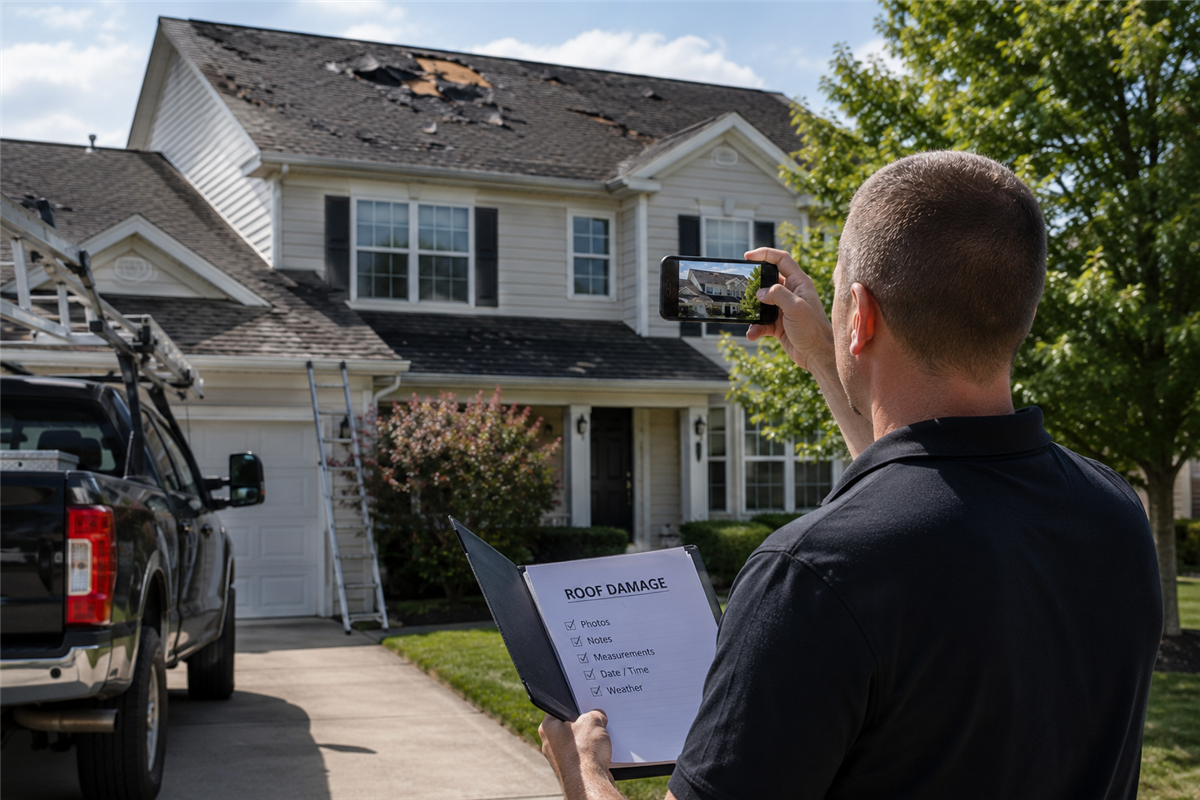
The goal in the first hour is control rather than perfection: contain the water inside, cover the opening outside, and buy yourself time. Photograph everything before you clean up. Those images become the backbone of an insurance claim.
Head into the attic with a flashlight and look for daylight through the deck, dark stains on the sheathing, or matted insulation. Wet fiberglass loses nearly all of its R-value, so pull back the batting around the leak and set it aside to dry rather than leaving it compressed and soaked.
A trick that works well in older DMV homes with finished ceilings: staple a length of plastic sheeting to the rafters, shape it into a shallow trough, and run it toward a bucket or out through a soffit vent. You're steering the water instead of chasing it. Run a fan or dehumidifier in the space, because mold can take hold in wet building materials within 24 to 48 hours. Move furniture, rugs, and anything electronic out from under the affected ceiling, and keep checking the spot after each rain. A patch that held through a drizzle may not hold through the next thunderstorm, which is exactly why a temporary fix for missing shingles should always be followed by a proper repair from a crew like NV Roofing.
How Long a Temporary Fix Really Lasts
A patch buys time. That is its entire job. What homeowners actually need to know is how much time they are buying, and whether the roof underneath deserves a targeted repair, a section replacement, or a clean start. Here is how to make that call with evidence instead of guesswork.
The answer depends entirely on the method used. A properly battened tarp stretched over the ridge will hold through a DMV winter, roughly one to three months, before UV exposure makes the poly brittle and the fasteners begin working loose. A replacement shingle slotted in and nailed correctly can last a year or more, though it carries no manufacturer warranty. Peel-and-stick membrane applied to dry decking in warm weather bonds well, but it breaks down quickly once direct sunlight hits it, so plan on weeks rather than seasons.
A temporary fix for missing shingles stops water intrusion. It does not restore the roof's wind rating, its warranty, or its ability to shed water as a continuous system.
Five Checks Before You Decide the Patch Is Enough
Before you decide the patch is good enough, run through this five-point assessment to find out what condition the rest of the roof is really in:
- Count the gaps: One or two missing shingles on an otherwise sound roof is a repair. Six or more scattered across multiple slopes points to a failed sealant strip across the whole field.
- Check your gutters and downspout splash blocks: Heavy granule buildup means the asphalt mat is exposed and the surrounding shingles are already aging out.
- Press gently on the decking near the gap: Any sponginess under your palm means water has already reached the sheathing, and that section needs to come off.
- Find the installation date: Pull your original invoice or closing documents. Architectural shingles in this climate typically run 20 to 30 years; three-tab, closer to 15 to 20.
- Inspect the flashing, pipe boots, and ridge vent: Cracked rubber boots and rusted step flashing usually fail around the same time the shingles do.
Working through those checks in order tells you whether you are solving a contained problem or simply postponing a much larger one.
When the Roof Is Telling You It Needs More Than a Patch
Some roofs tell you plainly. Curled or cupped edges across entire slopes, widespread bald patches, shingles that crumble when you flex them, or a deck that visibly sags between rafters all point in the same direction. So does a third repair call in two years.
Insurance plays a role in the decision as well. When a storm damages enough squares, carriers often fund a full slope or the entire roof rather than a spot fix. The National Roofing Contractors Association recommends documented professional inspections twice a year, and that paper trail is often what separates an approved claim from a denied one.
The table below lays out the three options side by side so you can see what each one is suited for, how long it holds, and what warranty protection comes with it:
How NV Roofing Handles Missing-Shingle Storm Damage
A tarp buys you time. What you do with that time decides whether this becomes a footnote or a five-figure problem. NV Roofing has worked on DMV homes since 1963, and the pattern rarely changes: homeowners who move from a temporary fix for missing shingles to a permanent repair within a few weeks spend a fraction of what the ones who wait out the season do.
When wind strips shingles off a Fairfax or Montgomery County roof, our storm response starts with an inspection, not a sales pitch. Crews document the damage, tarp the exposed sections properly (over the ridge, battened down, not grommet-and-rope), then walk you through what they found on the decking, the flashing, and the surrounding courses. Nobody has to climb a wet roof at 7 a.m. to find out how bad it is.
That distinction matters more than most homeowners expect. A tarp thrown over a bare patch and weighted with bricks will lift in the next 40 mph gust and leave you wetter than before. A tarp run over the ridge and fastened to solid wood holds through the storm and keeps water out of the insulation, the drywall, and the framing while you make a decision about the real repair.
The cheapest roof repair is almost always the one you make before the next storm, not after it. |
Our crews are factory-certified installers, which matters for one practical reason: manufacturers like GAF only extend their stronger warranty coverage when a qualified contractor installs the system as specified. That covers shingle, metal, and specialty roofing, and it carries through the rest of the exterior too, from seamless gutters and guards to James Hardie fiber cement siding and energy-efficient replacement windows.
It also means the repair gets done the way the manufacturer intended. Shingles are sealed to the course below, flashing is replaced rather than re-caulked, and ventilation is checked so the new work is not fighting trapped heat from underneath. Those details are invisible from the ground and they are exactly what separates a repair that lasts a decade from one that fails next spring.
Here is how we match the response to the condition of the roof, so you can see where your situation likely falls before we ever get on a ladder.
Wind and hail claims live or die on documentation. We photograph the damage, write it up in terms adjusters recognize, and sit in on the inspection so your claim reflects the whole scope, not just the shingles visible from the driveway. You get one point of contact, a written estimate before work begins, and a schedule you can plan around.
Insurance Documentation That Makes Claims Easier
A few habits make claims go smoother, and they cost you nothing but a little attention in the first day or two after the storm:
- Photograph everything early: take shots of the roof, the yard debris, and any interior staining before the tarp goes up.
- Note the date of the storm: carriers tie coverage to specific weather events, and a clear date keeps your file clean.
- Keep the temporary work receipts: emergency tarping is usually reimbursable under most policies as mitigation.
- Do not authorize permanent repairs before the adjuster visits: wait until the scope is agreed so nothing falls outside the claim.
Still staring at that bare patch? Contact us and we'll take it from here.
Protect the Roof Before the Next Storm
A bare spot on your roof isn't an emergency, but the clock is running. Get it covered properly, keep water away from the sheathing, and whatever damage happens stays small enough to handle with a simple repair. Reach for a tube of caulk and a tarp held down with bricks, and you'll be dealing with rot, mold, and a drywall contractor come spring. One weekend of real attention is usually what separates those two outcomes.
Work through it in order: check things out safely, cover the opening, take photos of what you find, then look at the rest of the roof before you decide one shingle was the whole problem. Dig up your last roofing invoice and see how old the roof actually is. Check the gutters for granule buildup. A temporary fix for missing shingles buys you time, so if what you're seeing suggests more than one isolated gap, book a professional inspection while that tarp is still holding – before the next storm makes the decision for you.
FAQs
Can I tarp a roof in light rain?
You can tarp in light rain if the surface is safe to walk, but adhesives and peel-and-stick membranes will not bond to a wet deck. If the roof is slick or wind is still gusting, wait it out or call a crew with proper fall protection.
Will insurance reimburse emergency tarping?
Most policies reimburse reasonable mitigation costs, including emergency tarping, as long as you keep the receipts and photograph the damage before the cover goes on. Check with your carrier before authorizing any permanent work so the repair stays inside the approved scope.
How much does it cost to replace one missing shingle?
A single shingle replacement is typically one of the least expensive roofing calls there is, especially compared to replacing water-damaged sheathing. Costs climb quickly once the deck softens or the surrounding courses have lost their seal.
Is it safe to inspect missing shingles myself?
Only in dry, calm weather, with soft-soled shoes and a ladder tied off at the top, and only if the pitch is gentle enough to stand on comfortably. A pair of binoculars from the ground answers most questions without any risk at all.
Can a temporary repair void my roof warranty?
Emergency measures like tarping rarely void coverage, though DIY patching with caulk or non-approved adhesives can give a manufacturer grounds to deny a claim. Have a factory-certified contractor handle the permanent repair so your warranty stays intact.
Subscribe to NV Roofing's Blog