| Commercial roof leak detection methods range from visual inspections and infrared thermography to electronic leak detection, flood testing, nuclear moisture gauging, and capacitance testing, each suited to different roof types, budgets, and levels of precision. Early detection is critical because the real cost of a roof leak comes not from the repair itself but from secondary damage to insulation, interiors, and tenant spaces that accumulates while the leak goes unnoticed. |
A small roof leak on a commercial building never stays small. A few drops behind a ceiling tile can turn into saturated insulation, damaged inventory, and mold growth within weeks. The source, meanwhile, stays hidden beneath layers of roofing membrane.
Finding the leak early is where the real savings happen. According to industry data, water intrusion costs building owners significantly more in secondary damage than in actual roof repairs.
This article covers six proven commercial roof leak detection methods, from basic visual inspections to infrared thermography and electronic testing. You'll learn how each technique works, when to use it, and what typically causes leaks on flat and low-slope roofs. Whether you manage one office building or a portfolio of properties across Northern Virginia, Maryland, and D.C., you'll walk away knowing exactly which detection method fits your situation and budget.
Why Early Leak Detection Protects Your Bottom Line
Roof leaks don't send you a calendar invite before they cause damage. When a water stain finally shows up on a ceiling tile or a tenant reports a musty smell in their office, the leak has probably been active for weeks, sometimes longer. For property managers and building owners, the window between when a leak starts and when it's actually found is what determines how much it ends up costing.
The Hidden Cost of Undetected Roof Leaks
The repair bill for the roof itself is usually the smallest line item. What gets expensive is everything the water touches on its way down. Saturated insulation loses its R-value, which drives up energy bills month after month. Wet drywall and ceiling systems can't just be dried out; they need full replacement. Electrical components exposed to moisture create safety hazards and code violations. And if inventory, equipment, or tenant property takes water damage, you're facing liability claims stacked on top of repair costs.
There's also the health side. According to the U.S. EPA, mold can begin growing on wet surfaces within 24 to 48 hours and has the potential to cause allergic reactions, asthma attacks, and irritation of the eyes, skin, and lungs. In a commercial building with tenants and employees, that creates serious operational risk and legal exposure that goes well beyond a roof patch.
| The roof repair is rarely the expensive part. It's the weeks of undetected water migration through insulation, decking, and interior finishes that drive costs up dramatically. |
Warning Signs That a Leak May Already Be Present
Some leaks are obvious, but most of them aren't. The challenge with flat and low-slope commercial roofs is that water can travel horizontally along the deck or membrane before it ever drops into the building. That means the visible damage inside could be ten or twenty feet away from where the water is actually getting in.
Here are common indicators that should prompt an immediate investigation:
- Discolored or sagging ceiling tiles: Particularly after rain events, this suggests moisture is pooling above the finished ceiling and saturating materials.
- A persistent musty odor in specific rooms or corridors: This often points to hidden mold growth from an ongoing leak that hasn't surfaced visually yet.
- Unexplained increases in heating or cooling costs: Wet insulation loses its thermal performance, and your HVAC system has to work harder to compensate.
- Bubbling, blistering, or soft spots on the roof membrane: These indicate trapped moisture beneath the surface that's already compromising the roof system.
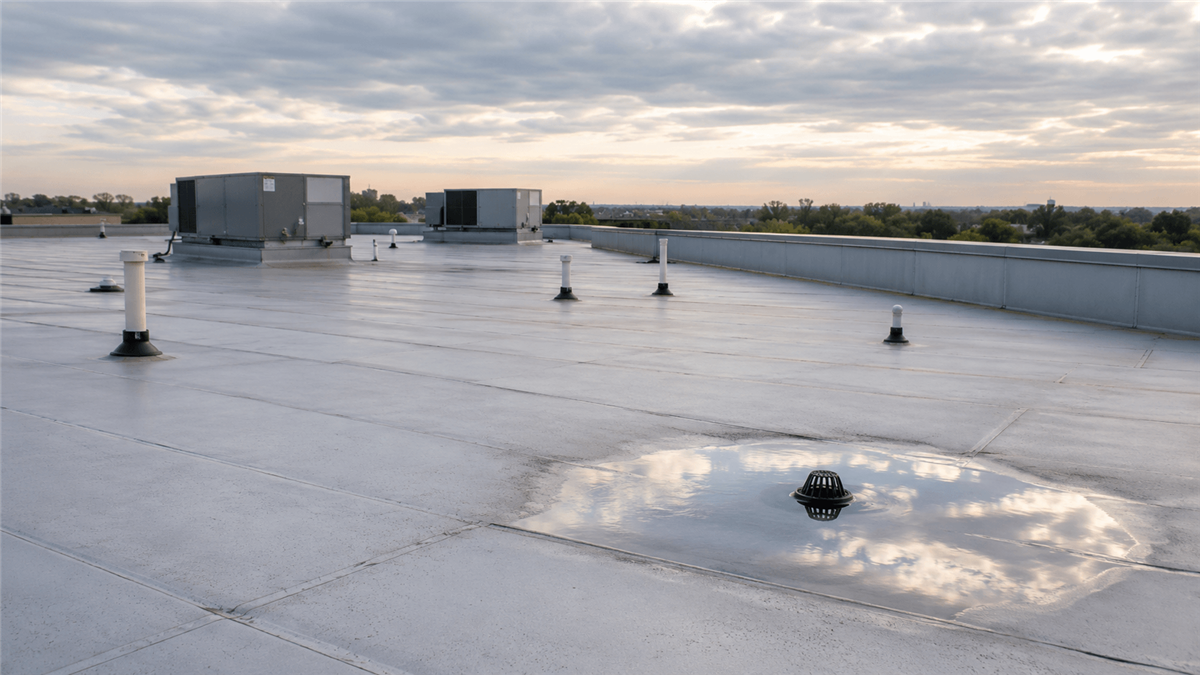
- Ponding water remaining on the roof more than 48 hours after rainfall: Standing water puts sustained pressure on seams and flashings, accelerating deterioration at the most failure-prone points.
If a leak only shows up during heavy rain but not during lighter storms, that usually points to issues at specific penetrations or flashing details that only fail under higher water volume. It's a pattern worth documenting when you schedule a commercial roof leak detection assessment, because it helps narrow down the source and saves time during the inspection process.
6 Professional Methods for Commercial Roof Leak Detection
Not every leak calls for the same detection approach. The right method depends on your roof type, the suspected location, and how much disruption your building operations can handle. Here's how each of the six primary commercial roof leak detection techniques works, along with when each one makes the most sense.
Visual Inspection
This is the starting point for virtually every leak investigation. A trained inspector walks the roof surface looking for obvious defects: blistering, ponding water, open seams, cracked caulking, and deteriorated flashing around penetrations like HVAC units and vents. Inside the building, they check ceilings, walls, and insulation for staining, sagging, or musty odors.
Visual inspections are fast and inexpensive, but they have a clear limitation. They can only identify what's visible. Moisture trapped beneath the membrane or inside insulation layers won't show up until the damage has progressed significantly. That said, a thorough visual assessment by an experienced roofer often catches problems that more expensive technology would confirm anyway. It's always the logical first step.
Infrared Thermography
Infrared (IR) cameras detect temperature differences across the roof surface. Wet insulation retains heat longer than dry insulation after the sun goes down, so moisture-saturated areas appear as warm spots on a thermal image. Inspectors typically perform IR scans in the evening, once the roof has begun cooling.
This method covers large areas quickly and doesn't require any physical contact with the membrane, meaning zero risk of additional damage. Equipment from manufacturers like FLIR and Fluke is commonly used for these surveys. The tradeoff? IR thermography shows where moisture is present, but it doesn't pinpoint the exact entry point of the leak. It works best as a mapping tool that narrows down the search area before a more targeted technique is applied.
Electronic Leak Detection (ELD)
ELD is one of the most precise methods available for locating breaches in single-ply and modified bitumen membranes. There are two variations: low-voltage and high-voltage. Low-voltage ELD works by wetting the roof surface and using an electrical field to find the path of least resistance, which is where the membrane has a hole or defect. High-voltage ELD uses a charged broom or wand swept across a dry membrane to detect breaches without water.
ELD can locate openings as small as a pinhole, making it exceptionally useful for quality assurance after a new installation or repair. It does require a conductive deck beneath the membrane, so it won't work on every roof assembly. For property managers who need surgical accuracy in their commercial roof leak detection efforts, this is often the go-to choice.
Flood Testing
Flood testing is exactly what it sounds like. Sections of the roof are temporarily dammed with sandbags or inflatable barriers, then flooded with a controlled amount of water. Inspectors watch from inside the building for signs of water penetration over a set period, usually 24 to 48 hours.
It's a straightforward, low-tech approach that confirms whether a specific area is watertight. The obvious downside is that it adds significant weight to the roof structure, so a structural engineer should verify load capacity before testing begins. Flood testing also takes time and can only cover one section at a time, which makes it impractical for surveying an entire roof. It's best reserved for confirming a suspected problem area or verifying that a completed repair is actually holding.
Nuclear Moisture Gauging
This technique uses a small radioactive source to measure hydrogen content in roofing materials. Because water contains hydrogen, elevated readings indicate moisture trapped within insulation or between membrane layers. The gauge is placed directly on the roof surface at a grid of test points, and results are recorded on the spot.
Nuclear gauging is non-destructive and provides quantitative data (actual moisture percentages rather than just “wet” or “dry”). It does require a licensed operator due to the radioactive element, and it reads a relatively small area per measurement. For large roofs, it's often paired with infrared thermography: the IR scan identifies suspect zones, and the nuclear gauge confirms and quantifies the moisture levels within those zones.
Capacitance Testing
Capacitance meters measure the dielectric properties of roofing materials, which change when moisture is present. The device is swept across the roof surface, and areas with higher-than-normal readings are flagged for further investigation or core sampling.
This method is completely non-destructive and doesn't involve any hazardous materials, which gives it a practical edge over nuclear gauging for some building owners. However, capacitance testing is sensitive to surface conditions (standing water, metal flashing, or debris can produce false readings), so it requires a clean, dry membrane surface for reliable results. It works well as a screening tool on EPDM and TPO roofs where you need a quick read on overall moisture conditions across a broad area.
Common Causes of Commercial Roof Leaks
Knowing how to detect a leak is only half the equation. Understanding why leaks happen in the first place helps you prevent them, or at least catch them before they turn into expensive emergencies. Most commercial roof failures trace back to a handful of recurring causes, and nearly all of them are preventable with the right attention and maintenance rhythm.
Flashing Failures and Membrane Damage
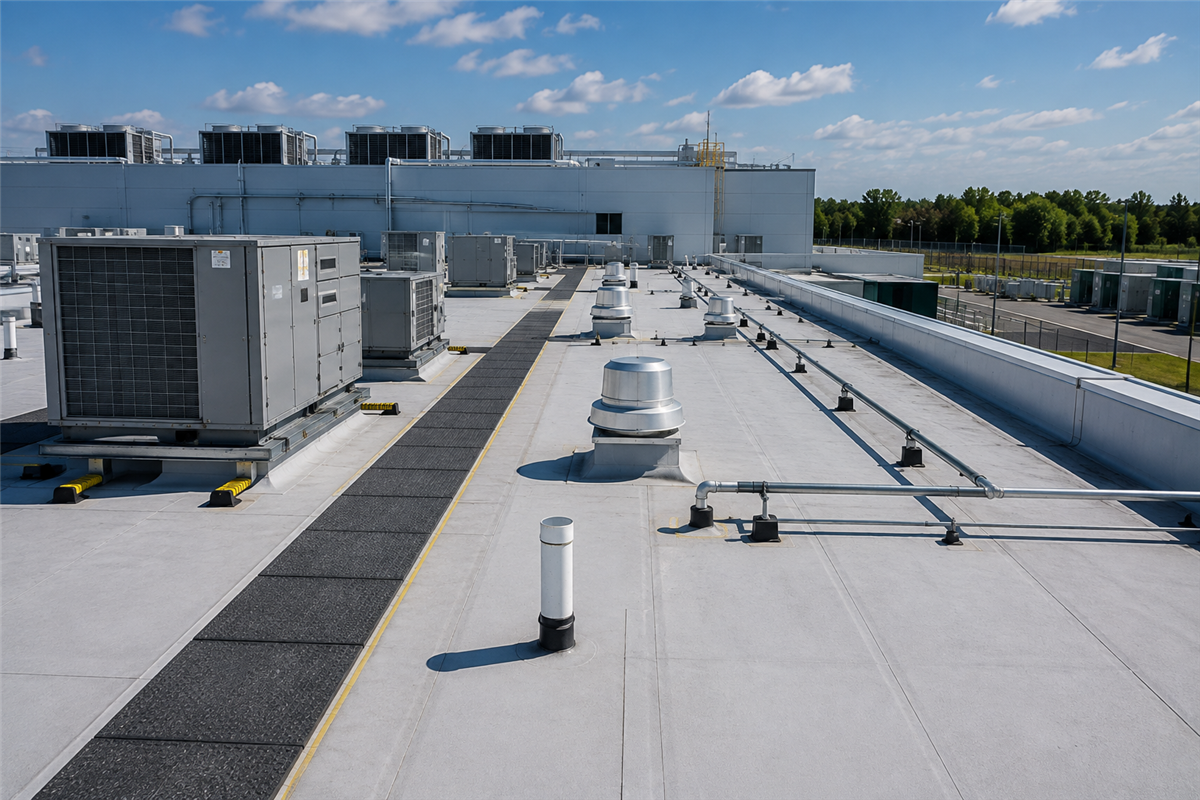
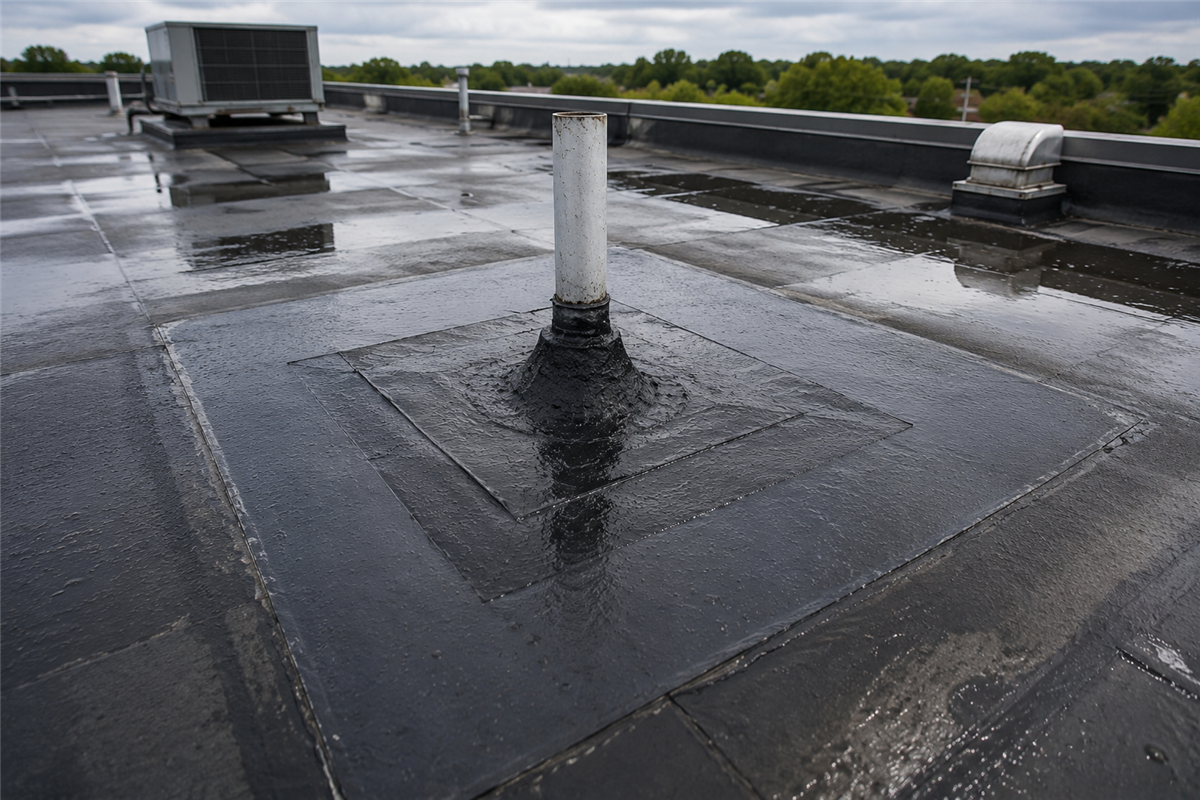
Flashing is the metal or membrane material that seals every transition point on your roof: where the deck meets a parapet wall, around HVAC curbs, at pipe penetrations, and along expansion joints. These areas absorb more thermal movement and handle more concentrated water flow than any other part of the roof, so they tend to fail first. Sealant dries out and cracks. Metal separates from the substrate. Membrane boots around pipes deteriorate after years of UV exposure and temperature cycling.
The membrane itself can also develop problems independent of flashings. Foot traffic from maintenance crews servicing rooftop equipment creates scuffs and punctures, especially on single-ply systems like TPO and EPDM. Dropped tools, dragged equipment, and even displaced gravel on BUR (built-up roofing) systems all introduce weak points that water will eventually exploit. Any commercial roof leak detection program should prioritize these high-traffic zones during routine inspections.
| Flashing details account for the majority of commercial roof leak origins because they sit at the intersection of different materials, planes, and movement forces. |
Drainage Issues and Aging Materials
A flat roof that drains properly can last decades. One that doesn't will develop problems much sooner. Clogged internal drains, debris-filled scuppers, and sagging areas that trap standing water all create conditions where moisture sits on the membrane far longer than it should. That sustained contact accelerates material breakdown and puts constant hydrostatic pressure on seams, turning minor imperfections into active leak paths.
Age compounds every drainage problem. Roofing membranes lose flexibility and UV resistance over time. Adhesives weaken at the molecular level. Insulation compresses under mechanical loads, creating new low spots where water collects. A 20-year-old roof with minor ponding issues carries a very different risk profile than a 5-year-old roof with the same ponding. If your building's roof is approaching the back half of its expected service life, drainage deficiencies deserve extra scrutiny during every seasonal check.
Improper Repairs or Installation
This one is frustrating because it's entirely avoidable. Poorly executed patch jobs, incompatible materials layered on top of each other, and shortcuts taken during original installation are responsible for a surprising number of leak callbacks. A common example: using a silicone-based sealant on an EPDM membrane that actually requires a specific EPDM-compatible adhesive. The patch looks fine for a few months, then peels away at the edges and lets water underneath.
| Patching the same area year after year, especially around drains, is a clear sign that the underlying issue hasn't been addressed. Repeated repairs without solving the root cause simply delay a larger failure. |
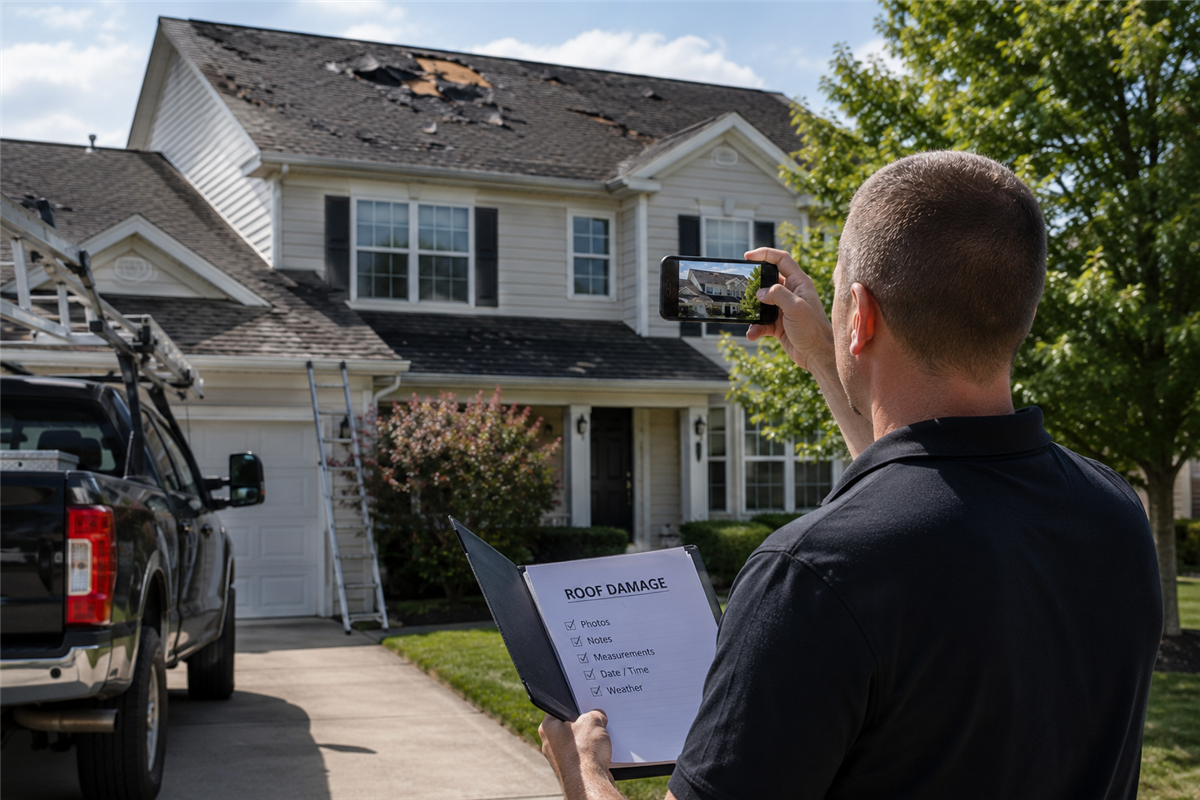
If you suspect that recurring leaks stem from installation or repair quality, here's a straightforward process to diagnose and document the issue before calling in a contractor:
- Map every interior leak location on a floor plan, noting dates and weather conditions when each occurrence was observed.
- Access the roof and photograph the area directly above each interior leak point, including all penetrations, seams, and previous patches within a 20-foot radius.
- Check whether repair materials match the existing membrane system (TPO to TPO, EPDM to EPDM) and whether manufacturer-approved primers and adhesives were used.
- Document any signs of improper drainage: blocked scuppers, debris around drain baskets, or areas where water appears to travel laterally before entering the building.
- Compile your findings into a single report with photos and share it with your roofing contractor so the commercial roof leak detection assessment starts with solid baseline data.
Following this process before a professional arrives saves time, reduces diagnostic costs, and ensures no detail gets overlooked during the inspection. It also gives you leverage when evaluating contractor recommendations, since you'll already understand the condition of your roof firsthand.
Is Your Commercial Roof a Managed Asset or a Future Emergency?
NV Roofing's complimentary inspection gives you a full condition report, capital risk assessment, and remaining service life estimate. A $2,400 value at no cost.
Claim My Free Inspection →
How NV Roofing Helps You Stay Ahead of Roof Leaks
Knowing which detection method to use is one thing. Having a roofing partner who actually shows up, conducts the right assessment, and follows through with lasting repairs is something else entirely. That's where NV Roofing's commercial services come in for property managers and building owners across Northern Virginia, Maryland, and D.C.
Commercial Roofing Services Built Around Partnership
NV Roofing has served the DMV region since 1963, and the commercial division is built around long-term relationships rather than one-off transactions. The team works alongside property managers and asset management firms to keep roofs performing year after year, addressing problems before they escalate instead of simply patching what's already failed.
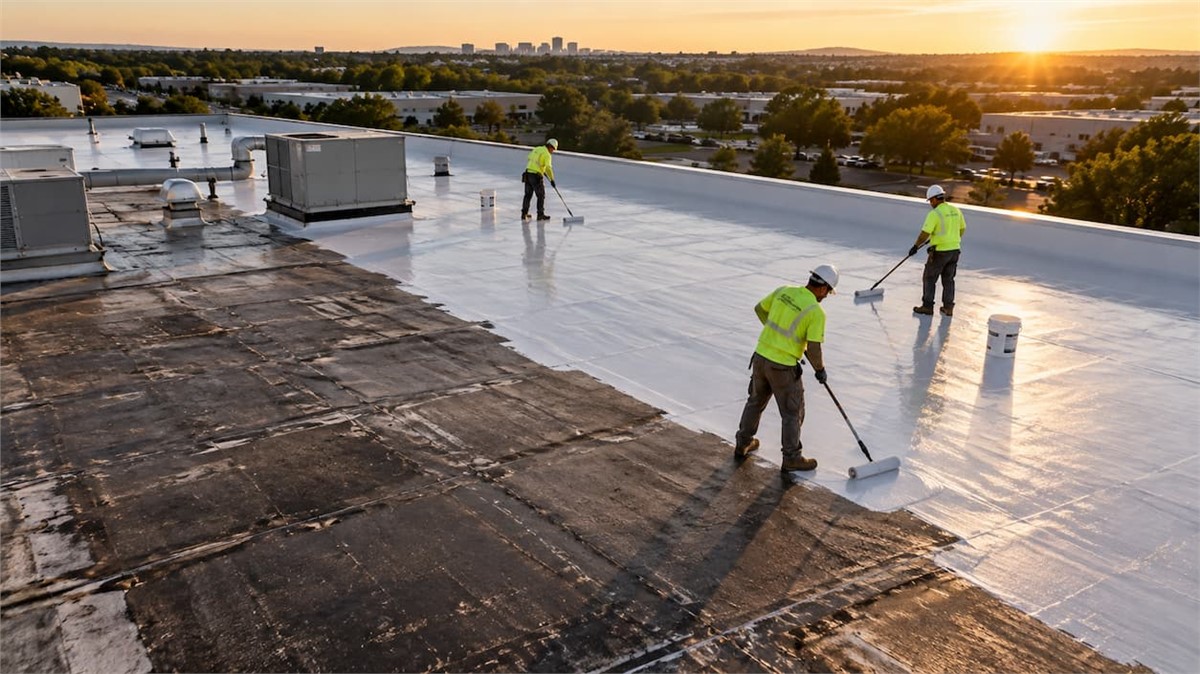
Commercial roof leak detection is only useful if the findings lead to the right repair. NV Roofing's commercial services cover installation, repair, restoration, and coatings for office buildings, apartment complexes, industrial facilities, and retail spaces. The team also handles siding, windows, gutters, and drainage systems, because a roof leak isn't always a roof problem. Sometimes it's a flashing-to-wall transition or an undersized gutter system that's directing water where it shouldn't go.
For storm damage situations, NV Roofing deploys rapid-response teams to restore properties quickly, helping building owners minimize tenant disruption and avoid prolonged downtime.
Reactive vs. Preventive Approach to Commercial Roof Leaks
The following table breaks down how a reactive approach compares to a preventive one across the factors that matter most to building owners and property managers.
| Factor | Reactive (Fix When It Leaks) | Preventive (Scheduled Maintenance) |
| Average repair cost per incident | Higher (includes secondary damage) | Lower (catches issues early) |
| Tenant disruption | Frequent and unpredictable | Minimal and planned |
| Roof lifespan impact | Shortened by repeated water damage | Extended through consistent upkeep |
| Budget predictability | Unpredictable emergency expenses | Predictable annual investment |
Preventive Maintenance That Extends Roof Life
The most effective commercial roof leak detection strategy is one that catches problems before they become leaks at all. NV Roofing's NV Priority Plus maintenance program is designed around exactly that idea. It includes scheduled inspections, minor repairs, and priority service so that small membrane issues, clogged drains, or deteriorating sealant get addressed on a routine basis.
| A scheduled inspection twice a year costs a fraction of what a single undetected leak can cause in damage to insulation, ceilings, and tenant spaces. |
For building owners managing multiple properties, this kind of structured program turns roof care from an unpredictable expense into a planned line item. And because the same team handles both inspections and repairs, nothing gets lost between diagnosis and fix.
If you manage commercial properties in the DMV area and want a partner who treats your roof like the asset it is, contact us to start the conversation.
Catching Leaks Early Is the Best Investment You Can Make
Every commercial roof leak detection method covered here serves a specific purpose, and the right choice depends on your roof system, the severity of the suspected issue, and how much operational disruption you can tolerate. The math, though, never changes. Finding moisture intrusion early costs a fraction of what you'll spend fixing water damage that's been quietly spreading for months. Whether you rely on infrared scans for broad coverage or electronic testing for pinpoint accuracy, the end goal is the same: protect the building, protect the tenants, and protect your budget.
If it's been more than twelve months since a professional took a close look at your commercial roof, that should be your next move. Pick up the phone, schedule an inspection, and get a clear picture of where things stand before the next heavy rain makes the decision for you.
FAQs
Should I check roof drains or the membrane first when tracking down a leak?
Start with the drains, scuppers, and gutters since clogs are the fastest issue to rule out and one of the most common causes of ponding that leads to membrane failure. If drainage is clear, then move on to inspecting the membrane, flashings, and penetration points.
What if the leak only shows up during heavy rain but not during lighter storms?
That pattern typically points to a defect at a specific flashing detail or penetration that only fails when water volume exceeds a certain threshold. Sharing that observation with your inspector helps narrow the search area and makes the commercial roof leak detection process significantly faster.
How do I tell the difference between a roof leak and condensation forming near pipes or HVAC equipment?
Condensation tends to appear consistently regardless of weather and is usually concentrated around cold surfaces like pipes and ductwork, while a roof leak correlates with rain events and often leaves mineral staining or discoloration on ceiling materials. A professional can use infrared thermography to quickly distinguish between the two sources of moisture.
What types of commercial buildings benefit most from professional leak detection services?
Buildings with flat or low-slope roofs, heavy rooftop mechanical equipment, or moisture-sensitive interiors like data centers, medical offices, and warehouses storing inventory gain the most value from commercial roof leak detection because the consequences of undetected water intrusion are especially costly in those environments.
What happens if we keep patching the same area of the roof year after year?
Repeated patching without addressing the root cause, whether it is a drainage problem, incompatible materials, or structural movement, usually accelerates deterioration of the surrounding membrane and can void manufacturer warranties. It is almost always more cost-effective to invest in a proper repair or localized restoration than to continue layering temporary fixes.
Subscribe to NV Roofing's Blog