| How do I file a claim for roof damage? Document the damage with dated, scaled photos before you tarp or clean up, read your policy's roof valuation and wind/hail deductible, get an independent inspection, and only then call your carrier, because the first inspection sets the scope of loss that caps your payout. Filing only makes sense when repair costs clearly exceed your deductible, and a denied or underpaid claim can still be reopened through supplements, the appraisal clause, a public adjuster, or a complaint to your state insurance regulator. |
Here's what nobody tells you after a storm: the order you do things matters more than the forms you sign. Most homeowners call the carrier first and document second, and that flip quietly caps what the file can ever be worth. Whoever inspects first sets the baseline everything else gets measured against. Once shingles are tarped, debris is swept, and hail bruises have weathered over, you're arguing from memory instead of evidence.
So if you're wondering how do i file a claim for roof damage, this guide walks the storm damage claim steps in the sequence that protects your payout: document, read your policy, get an independent look, then decide whether filing makes financial sense at all. You'll also learn when to hire a public adjuster, what the carrier's inspector is actually looking for, and your next move if your roof claim is denied or underpaid. Just the roof insurance claim process, explained honestly.
The Order of Operations Beats the Paperwork
Every homeowner we meet after a hailstorm asks the same three things: which form, what deadline, whose number do I call. Fair questions, all of them. But most claims are won or lost before any of that happens, in the first 48 hours, decided entirely by what got photographed and who put eyes on the roof first.
How Do I File a Claim for Roof Damage Without Capping My Own Payout?
Start with the question homeowners type into their phones while standing in the driveway: how do i file a claim for roof damage without shortchanging myself? The answer is that you slow down for one day. Reporting a loss opens a file, and that file gets built around whatever evidence exists at the moment the carrier's adjuster climbs the ladder. If you tarped the roof, swept the yard, and hauled off the torn shingles before anyone took a picture, you erased the proof and kept the damage.
The sequence that protects you runs in a specific order: document everything, verify what your policy actually covers, get an independent set of eyes on the roof, then decide whether to file. Filing is the fourth move, not the first one. Storm damage claim steps done in that order give you leverage; done backwards, they hand the carrier the pen.
What the First Inspection Actually Decides
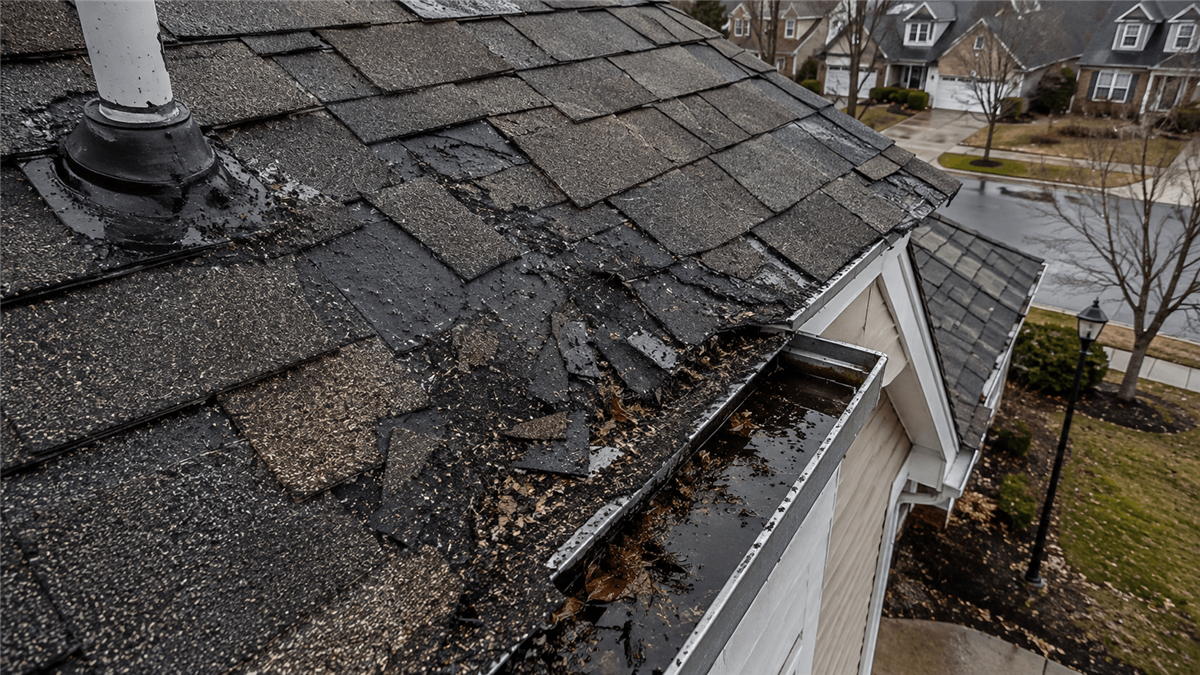
Insurance adjusters work from a scope of loss, an itemized list of what's damaged and what it costs to repair or replace. That scope sets the ceiling on your payout. Anything left off it, whether that's bent drip edge, bruised ridge cap, dented gutters, or damaged siding on the storm-facing elevation, is money you never see unless you fight to add it back later through a supplement.
Supplements are winnable, but they cost you weeks and require documentation you should have gathered on day one. This is also where a roof claim denied for “wear and tear” or “pre-existing condition” usually starts: nobody established the storm date, the hail size, or the directional pattern of impact while the evidence was still fresh on the shingles.
| You should know what you have before you report what you have. |
The Roof Insurance Claim Process at a Glance
Here's the whole arc of the roof insurance claim process, so you can see where each step lands before we walk through them one at a time:
- Before the call: photograph the loss from the ground and the roof, read your policy's roof settlement terms (replacement cost value versus actual cash value) and your wind/hail deductible, then get an independent inspection so you know the true size of the damage.
- The decision point: weigh the repair estimate against your deductible, and settle the question of when to hire a public adjuster (a licensed advocate who works for you, not the carrier) before the file is ever opened.
- After the call: the carrier assigns an adjuster, schedules an inspection, issues a scope of loss and an actual cash value payment, then releases the withheld depreciation once the work is complete and invoiced.
Most homeowners start at bullet three. That's the whole problem, and it's the one thing NV Roofing tells every caller to fix before they dial their carrier.
Storm Damage Claim Steps, in the Right Sequence
Seven steps, roughly in this order. A few of them collapse into a single afternoon, but the sequence itself is what protects your file. Jump ahead and you hand the carrier the first version of the story, and the first version tends to be the one that sticks.
Step 1: Document Everything Before You Touch Anything
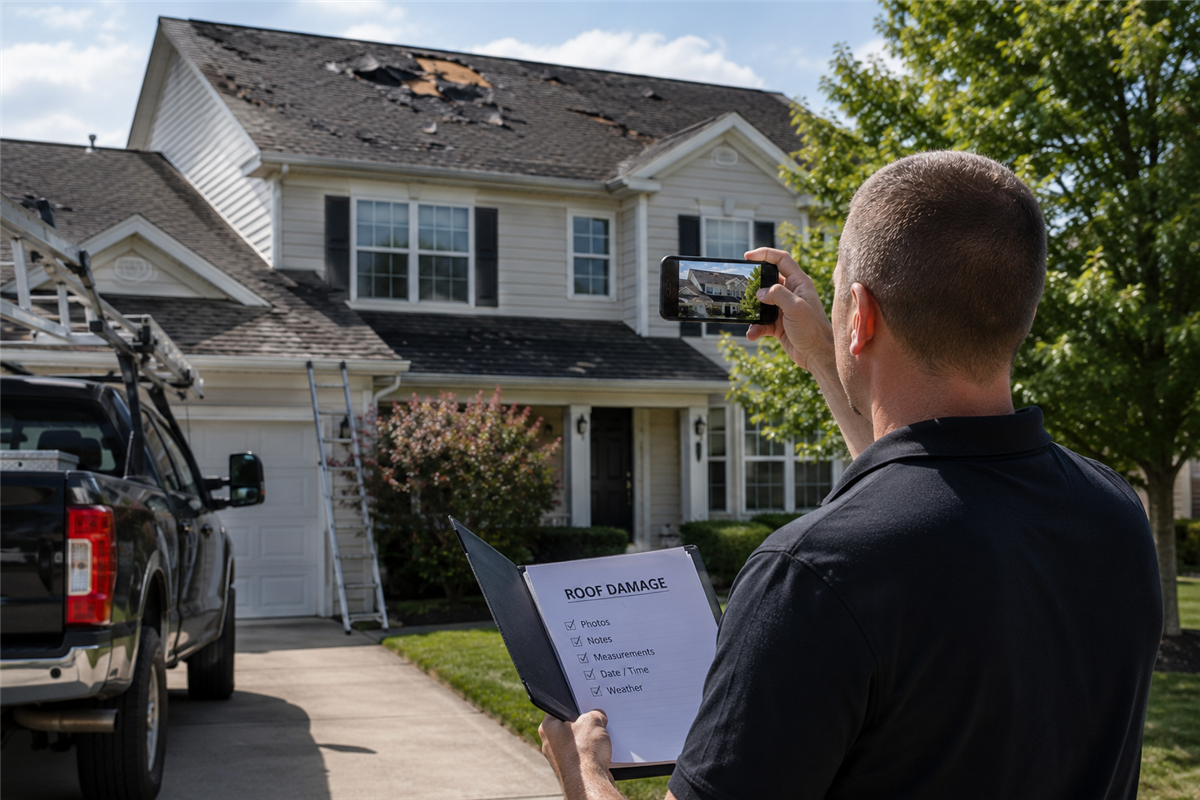
Before the tarp goes up, before you sweep the driveway, before you drag the soaked rug out to the curb, shoot the loss. Photos and video of the roof planes (from a ladder or a drone, never by walking a wet or steep slope), the attic decking and insulation, ceiling stains, wall streaks, and any water pooling on the floor. Get the gutters, downspouts, and window wraps too, because wind almost never damages a roof in isolation.
Two details turn snapshots into evidence. First, timestamps: leave your phone's metadata alone and resist the urge to crop, since the date the damage appeared matters as much as the damage itself. Second, scale. Set a quarter, a golf ball, or a tape measure next to hail bruises and impact marks so an adjuster can size the hits without guessing. Save the packaging from any tarp or plywood you buy and keep every receipt. Emergency mitigation is usually reimbursable, and it's the one repair you're allowed to make before an inspection happens.
Step 2: Read Three Things in Your Policy Before You Call
Your declarations page already answers most of the questions you're about to ask a stranger on the phone. Here are the three items worth reading before you dial:
- How the roof is valued: Replacement cost value pays what it takes to put a new roof back. Actual cash value pays that number minus depreciation for age and wear, and on a 17-year-old architectural shingle roof, that gap can run into five figures. Many carriers in Virginia, Maryland, and D.C. now attach a roof surfaces payment schedule that quietly converts older roofs to actual cash value even when the rest of the dwelling stays on replacement cost.
- Which deductible applies: You may have more than one. A separate wind/hail or named-storm deductible is often written as a percentage of Coverage A rather than a flat dollar amount, so 2% on a $600,000 dwelling limit means $12,000 out of pocket before the carrier pays a cent. In Maryland and Virginia, percentage hurricane deductibles generally trigger only for a named storm, which means ordinary summer thunderstorm damage falls under your standard deductible instead.
- The notice deadline: Most policies require “prompt” notice, and some carriers now write a hard window (commonly one to two years from the date of loss) for reporting wind and hail. Find that sentence and put the date on your calendar.
Step 3: Get an Independent Inspection First
You should know what you have before you report what you have. An independent inspection tells you whether the missing tabs are storm-created or the tail end of a roof that was already failing, whether hail actually fractured the mat or just knocked granules loose, and whether the damage is confined to a single slope. Wear-and-tear, manufacturing defect, and improper-installation exclusions live in every homeowners policy, and a contractor who inspects honestly will tell you when your damage lands in one of them. That answer costs you nothing now and saves you a great deal later.
Ask for the deliverable, not only the opinion: a written report with dated photos, slope-by-slope test squares, hail impact counts, and a line-item estimate. That document is what turns a phone call into a claim with a defined scope, and it's the backbone of the entire roof insurance claim process.
Step 4: Decide Whether the Claim Is Worth Filing at All
Sometimes the honest answer is don't file. If your inspection shows $4,100 in repairs and your wind/hail deductible is $12,000, there's no claim to make, only a repair to schedule. Should you file a roof claim for minor damage? Usually not. Property claims sit on your CLUE report for roughly seven years, and in a hardening DMV market, carriers weigh claim frequency heavily at renewal. Two claims inside three years can move you from a preferred tier to surplus lines, which costs far more over time than the small check you chased.
Filing clearly makes sense in a narrower set of situations: structural or decking damage, active interior water entry, damage across multiple slopes, or any loss where the repair estimate comfortably clears your deductible with room left over. When you're asking how do I file a claim for roof damage, the first honest question is whether you should.
Step 5: Decide Who Represents You, and When to Hire a Public Adjuster
The carrier's adjuster works for the carrier. A licensed public adjuster works for you, evaluating the loss, writing the estimate, and negotiating the settlement for a contingency percentage of the payout (state-capped in many jurisdictions, typically in the 10% range for non-catastrophe claims). You'll see a widely repeated statistic claiming public adjusters win roughly 19% larger settlements. That figure traces back to a Florida public adjuster trade association study, so read it as industry advocacy rather than neutral research.
Timing is the real answer to when to hire a public adjuster. Many prefer to be engaged before the claim is opened, so they can document the loss and frame the scope from day one rather than trying to reopen a scope someone else already set.
| Once you sign a final release, reopening the claim is severely restricted. Choose your representation while the file is still open, not after the check clears. |
Step 6: Filing, the Carrier's Adjuster Visit, and the Payout
Now you report. Give the date of loss, the cause, and the mitigation you performed, then attach your documentation package. The carrier assigns a field adjuster who inspects, chalks test squares, and writes an estimate in Xactimate.
Should your roofing contractor be present for that inspection? Yes. A contractor on the roof alongside the adjuster can point out soft metal dents, gutter-apron creasing, and collateral hits on vents that get missed from the ground, and can talk through line items in real time. You may also be asked for a sworn proof of loss, a notarized statement of the claimed amount, and its deadline is enforceable. The first check is typically actual cash value minus deductible. Depreciation is recoverable once the work is finished and you submit final invoices, so don't leave that money sitting unclaimed.
Step 7: Roof Claim Denied or Underpaid? Your Next Moves
A roof claim denied is a position, not a verdict. Request the full denial letter with the specific policy language and the adjuster's report, then answer it with evidence: an engineer's report, NOAA storm data for your ZIP code on the date of loss, or a supplemental estimate documenting omitted line items. Most carriers have an internal appeal channel, and most policies contain an appraisal clause that lets each side name an appraiser with a neutral umpire deciding the amount in dispute.
If that stalls, file a complaint with your state regulator: the Maryland Insurance Administration, the Virginia SCC Bureau of Insurance, or D.C.'s Department of Insurance, Securities and Banking. Public adjusters and policyholder-side attorneys do take mid-claim and post-denial files, so a claim you already opened yourself is far from finished.
Questions Homeowners Ask Before They Call the Carrier
These four questions come up on almost every post-storm inspection we run across Northern Virginia, Maryland, and D.C. Here are straight answers, including the parts homeowners don't love hearing.
Will Filing Raise My Premium or Cost Me My Renewal?
It can, and the outcome depends far more on your claim history than on any single loss. A first weather claim on a clean record is usually treated as a catastrophe event rather than a sign you're a risky customer, and plenty of carriers won't surcharge for it at all. A second or third property claim inside a few years is a different conversation. That's when you start seeing rate increases at renewal, a separate wind/hail deductible bolted onto the policy, or a non-renewal notice in the mail.
Regional loss trends matter just as much. When a hail swarm works over an entire county, carriers frequently reprice the whole book, so your neighbors' claims can nudge your premium even if you never filed a thing. That's a solid argument for filing legitimate losses and letting the marginal ones go, because you're paying into the same pool either way.
Who Pays the Public Adjuster, and Can I Hire One After Filing?
You do, and it comes out of your settlement. The public adjuster's contingency fee is taken off the top of whatever the carrier pays, so a 10% fee on a $30,000 settlement leaves you $27,000 toward a roof that costs $30,000. That math only works if the adjuster meaningfully expands the scope of the claim. Before you sign anything, verify the license through your state regulator's lookup and read the contract closely: the fee percentage: confirm whether it also applies to supplements and recoverable depreciation, and check exactly how you cancel.
Yes, you can bring one in mid-claim. Plenty of public adjusters take files that are already open, underpaid, or flatly denied, though knowing when to hire a public adjuster early gives them far more to work with than a file that's been mishandled for two months. If your roof claim denied letter is already sitting on the counter, that's a legitimate moment to make the call.
How Long Do I Have, and Does Insurance Cover an Old Roof?
Notice requirements are contractual, and they're separate from the statute of limitations on suing your carrier. Most DMV policies require prompt notice of loss with a defined outer limit, and waiting a full season while your evidence weathers away is an open invitation for a late-notice denial. Understanding the roof insurance claim process starts with pinning down your actual window. Here are the three steps that settle the question in one sitting:
- Pull the paperwork: read your declarations page and the “Duties After Loss” section of the policy, then note any stated reporting deadline for wind and hail.
- Confirm the date of loss: use third-party storm data rather than memory, either NOAA's storm events database or a free address-level tool like the roofquotes.com Hail Storm Impact Checker.
- Write both dates down: record the loss date and your deadline, then report well before the second one arrives.
Handling those three storm damage claim steps together removes the single easiest reason a carrier has to close your file without paying a dollar. It's also the first thing we check when a homeowner asks us how do I file a claim for roof damage after a storm that hit weeks ago.
| Age alone does not void coverage. A 20-year-old roof with genuine hail fractures is still a covered loss, it just may settle at actual cash value instead of full replacement cost. |
Where NV Roofing Fits Into Your Claim
In the first week after a storm, a contractor's job is to give you an accurate picture of the damage and put it in a form your carrier can act on. NV Roofing has been working DMV roofs since 1963, so we've watched how hail behaves on a 30-year architectural shingle in Loudoun County and how nor'easter wind peels a ridge in Montgomery County. More importantly, we know which of those an adjuster will pay for and which one gets marked “wear and tear” on the first pass.
That distinction matters because most homeowners asking how do i file a claim for roof damage start the call before anyone has actually been on the roof. Filing blind is the fastest route to a roof claim denied and a claim history entry you can't erase.
Emergency Tarping and Post-Storm Inspection Reports
Active water entry can't wait for an adjuster's calendar. We tarp first, photograph the condition underneath before the tarp goes on, and keep the mitigation invoice separate so it can be submitted as its own reimbursable line. Most policies cover reasonable emergency measures, but only if the paperwork is clean and dated.
The inspection that follows is documented slope by slope: test squares, hail impact counts, soft metal evidence on vents and gutter aprons, attic decking and underlayment condition, all photographed with dates attached. That record is what turns a phone call into a defensible file and keeps the roof insurance claim process moving instead of stalling on “insufficient evidence.”
| If the damage is cosmetic or the roof was already failing from age, we will tell you that before you open a claim you can't win. |
Roofing, Gutters, Siding, and Windows Under One Scope
Wind and hail rarely stop at the roofline. The same storm that bruised your shingles likely dented gutters, cracked siding on the storm-facing elevation, and stressed window wraps. Carriers pay for what's documented, and collateral damage found six weeks later is a supplement fight rather than a line item.
Because our residential work covers roofing, seamless gutters and guards, James Hardie fiber cement and vinyl siding, and energy-efficient replacement windows, one inspection captures the full loss. That beats three separate visits producing three separate estimates that never quite line up when the adjuster reads them side by side.
Who Does What on Your Roof Claim
People often confuse the three parties who show up during a claim, so here's who answers to whom and what each one actually produces:
| Role | Works For | What They Deliver |
| Carrier's field adjuster | The insurance company | Scope of loss and settlement estimate |
| Public adjuster | You, on contingency | Independent valuation and negotiation of the file |
| NV Roofing | You, as the contractor of record | Documented inspection, line-item estimate, and the completed repair |
Knowing when to hire a public adjuster comes down to the gap between the carrier's number and the real cost of repair. On a straightforward wind claim with solid photos, you likely don't need one. On a partially denied or badly underscoped file, a public adjuster earns their percentage.
Documentation Your Adjuster Can Actually Use
Our reports are built to sit next to a carrier's estimate: photo evidence tied to specific slopes, measurements, and line items written in the language adjusters price from. We meet the field adjuster on site, walk the roof together, and flag collateral damage in real time rather than chasing a supplement three weeks later.
The storm damage claim steps we follow with every homeowner stay the same, whether the loss is one slope or the whole envelope:
- Inspect before you file: we confirm there's a covered loss worth opening a claim over.
- Mitigate and invoice separately: tarping and temporary repairs get their own reimbursable line.
- Document by slope: dated photos, test squares, and impact counts, not a general summary.
- Meet the adjuster on site: agreement on scope happens on the roof, not over email.
- Recover depreciation: final invoices from factory-certified crews release the withheld holdback.
Storm damage on your roof and no photos yet? Contact us for an inspection before you call your carrier.
Document First, File Second, Settle Stronger
A storm claim is an evidence problem with a deadline stapled to it. The homeowners who walk away with a fair settlement usually aren't the ones who dialed the carrier first. They're the ones who already knew the true size of the loss, what their own policy actually said, and the number they had to hit before any form went in. So when people ask how do i file a claim for roof damage, the honest answer starts a step earlier than the phone call. Everything that follows in the roof insurance claim process (the adjuster's field visit, the line-item estimate, the depreciation held back until the work is done) is a negotiation over a record you either built or didn't.
Give yourself the day. Photograph the granules while they're still sitting on the driveway, print your declarations page, and get a qualified roofer up there to tell you whether there's a covered loss worth chasing. Those are the storm damage claim steps that pay for themselves later. Then call it in. And if you're reading this well past that point, sitting on a check that doesn't come close to the repair, or a roof claim denied outright, the file stays open as long as you keep pushing on it. That's usually the moment people start asking when to hire a public adjuster, and it's a fair question to ask out loud.
FAQs
Does homeowners insurance cover roof replacement?
Most policies cover full replacement when a sudden event like wind or hail damages enough of the roof that a repair won't restore it, but they exclude deterioration, poor installation, and manufacturer defects. Whether you get a new roof or a partial repair usually comes down to how much of the surface an adjuster finds damaged and whether your policy settles at replacement cost or actual cash value.
Do I need a contractor before filing an insurance claim?
You aren't required to have one, but homeowners who ask how do i file a claim for roof damage are almost always better off with a roofer's written assessment in hand first. Without it, you're describing damage you haven't measured and letting the carrier's adjuster define the scope on their own terms.
How long do I have to file a roof damage insurance claim after a storm?
Your policy's “Duties After Loss” section governs the timing, and many carriers now specify a hard reporting window measured from the date of loss rather than just requiring “prompt” notice. Waiting months also weakens your case, since weathering makes it harder to tie the damage to a specific storm date.
Should my roofing contractor be present when the insurance adjuster inspects?
Yes, having your contractor on the roof during the inspection lets both parties agree on the scope in person instead of trading revisions by email afterward. It's also the easiest way to make sure smaller items like vent hits, drip edge, and gutter aprons make it onto the estimate the first time.
What should I do if my roof insurance claim is denied?
Ask for the denial in writing with the exact policy provision cited, then rebut it with dated photos, third-party storm data, or an engineer's report rather than a phone argument. If the carrier holds firm, invoke your policy's appraisal clause or file a complaint with your state insurance regulator, since a denial early in the roof insurance claim process is rarely the end of the road.
Subscribe to NV Roofing's Blog