| Commercial roof inspection cost typically ranges from $300 to $2,500 depending on building size, roof type, number of penetrations, and whether advanced diagnostics like infrared scanning are included. Regular inspections catch small issues before they become major capital events, and structured programs can reduce total lifecycle roofing costs by 40 to 50% while extending roof lifespan to 40+ years. |
Roof problems don't send calendar invites. They show up as ceiling stains, surprise repair bills, or angry tenant emails. A professional inspection catches these issues early. But what should you actually pay for one?
Commercial roof inspection cost depends on your building's size, roof type, and how detailed the assessment needs to be. Prices range from a few hundred dollars to several thousand, and knowing what drives those numbers helps you spot fair quotes from inflated ones
This guide covers real price ranges, what a thorough inspection actually includes, and the specific factors that move the needle on cost. Whether you manage a single office building or a portfolio across the DMV region, you'll finish this knowing exactly what to expect on a proposal and how to turn a routine line item into a long-term money saver.
Why Commercial Roof Inspections Matter
Protecting Your Building's Value
Your roof represents a significant chunk of your building's total value, somewhere between 8% and 15%. That's not a component you want to ignore. When a membrane seam starts separating or a drain gets clogged with debris, the clock starts ticking on a chain reaction. Trapped moisture degrades insulation, insulation failure drives up energy costs, and eventually you're dealing with interior damage that affects tenants and daily operations.
A structured inspection program changes that entire dynamic. Instead of reacting to failures after they've already caused damage, you're spotting wear patterns and minor deficiencies while they're still cheap to address. The EPA's Moisture Control Guidance makes it clear that controlling water intrusion during building maintenance is one of the most effective ways to preserve structural integrity and indoor air quality. A roof inspection is exactly where that control begins.
| The cost of a commercial roof inspection is a fraction of a single emergency repair bill. The question isn't whether you can afford an inspection; it's whether you can afford to skip one. |
Insurance and Liability Considerations
Here's something a lot of property managers don't think about until it's too late: insurance carriers are getting more aggressive about roof condition. Underwriters now use aerial imagery and AI tools to assess roof risk before setting your premiums. If your building has no documented maintenance history, you're already at a disadvantage during policy renewals, and especially when filing storm damage claims.
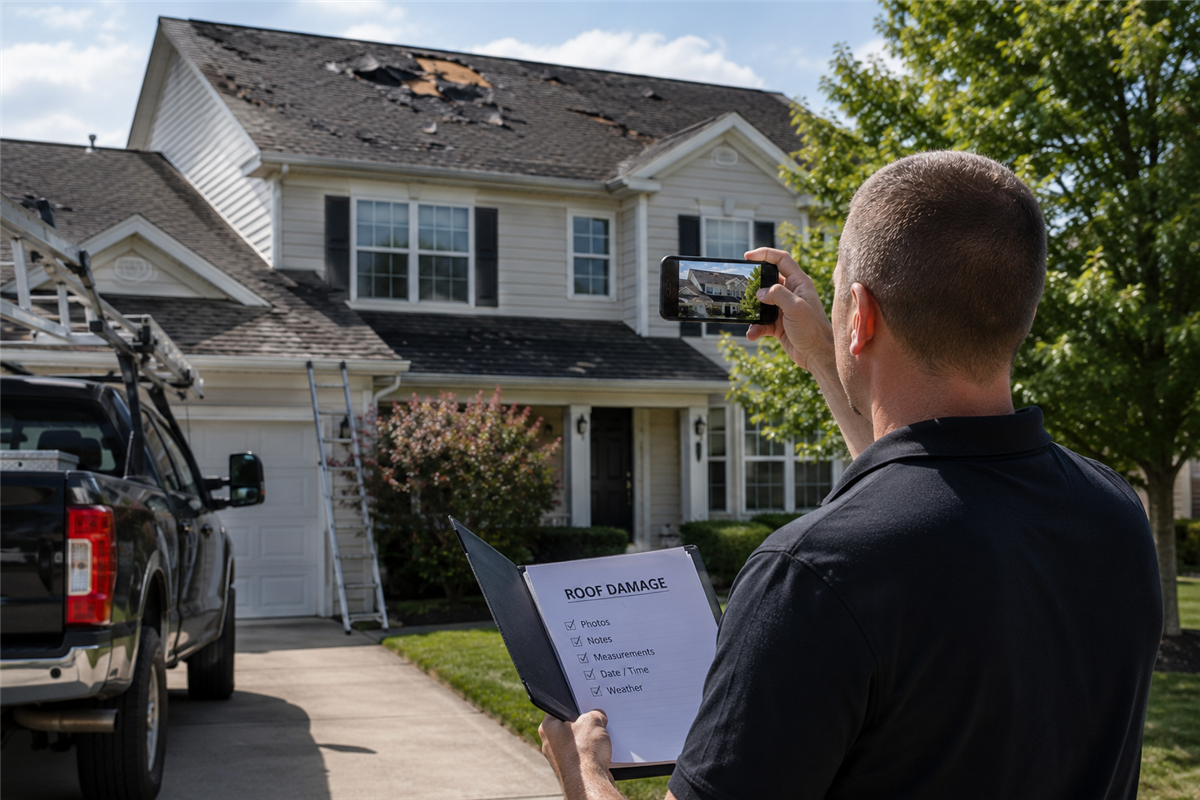
A documented inspection creates a baseline that works in your favor. When a hailstorm rolls through the DMV region and you need to file a claim, having a pre-storm condition report with photographs and specific findings gives that claim real teeth. Without documentation, you're asking the adjuster to take your word for it, and adjusters aren't in the business of doing that. Consistent commercial roof inspection records also reduce your liability exposure. If a leak causes a slip-and-fall or damages a tenant's inventory, demonstrating that you maintained the roof on a regular schedule strengthens your legal position considerably.
What's Included in a Commercial Roof Inspection?
Not all inspections are created equal. Some contractors walk the roof for ten minutes, snap a few photos, and hand you a vague summary. Others follow a structured checklist that accounts for every component standing between your building and the elements. Understanding what a thorough assessment actually looks like puts you in a better position to judge whether you're getting real value for your commercial roof inspection cost.
Visual Assessment and Drainage Review
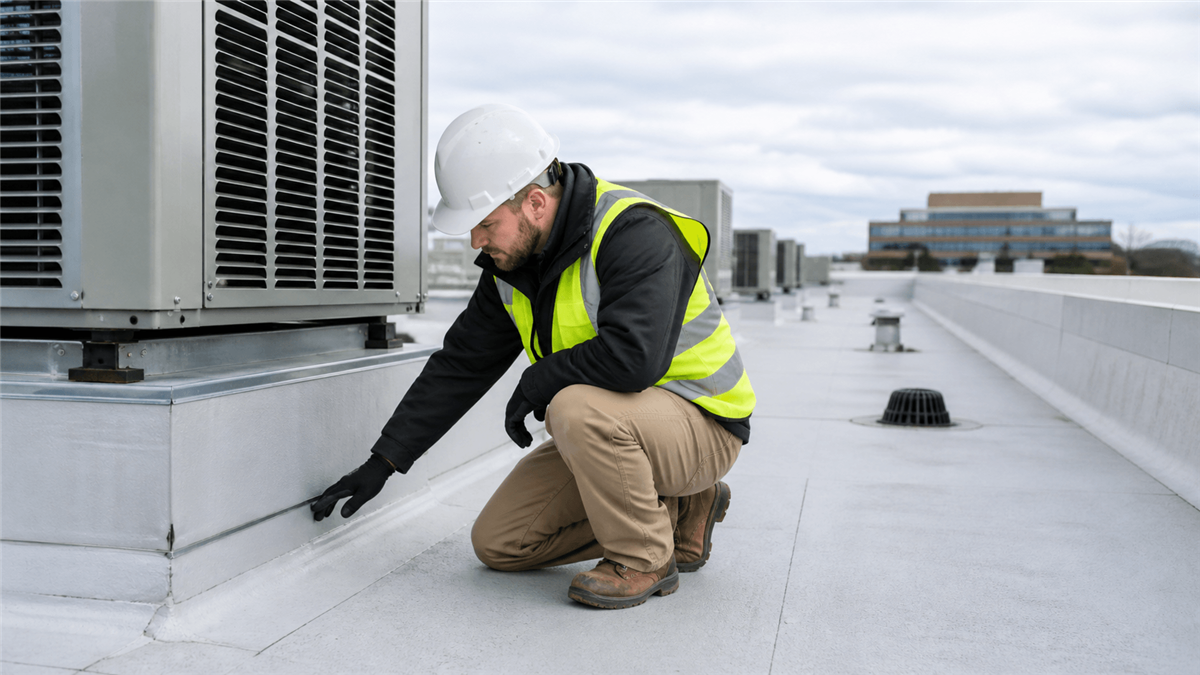
Every quality inspection starts with the fundamentals: a systematic walkthrough of the entire roof surface paired with a close look at how water moves off the structure. The inspector evaluates the overall condition of the roofing material, checks for debris buildup, and flags any areas where water is pooling. Ponding water is one of the most common issues on flat commercial roofs, and it's deceptively destructive. Even a half-inch of standing water adds weight, speeds up membrane breakdown, and creates ideal conditions for biological growth.
Drains, scuppers, and downspouts all get checked for blockages and proper flow. A clogged drain might seem like a minor problem, but during a heavy rainstorm it can turn your roof into a shallow pond in under an hour. According to Travelers Insurance's roof inspection guidance, keeping drainage systems clear and functional is one of the fundamental steps in any roof maintenance program, and inspectors should specifically look for evidence of standing water or ponding during every assessment.
Flashing, Seams, and Penetrations
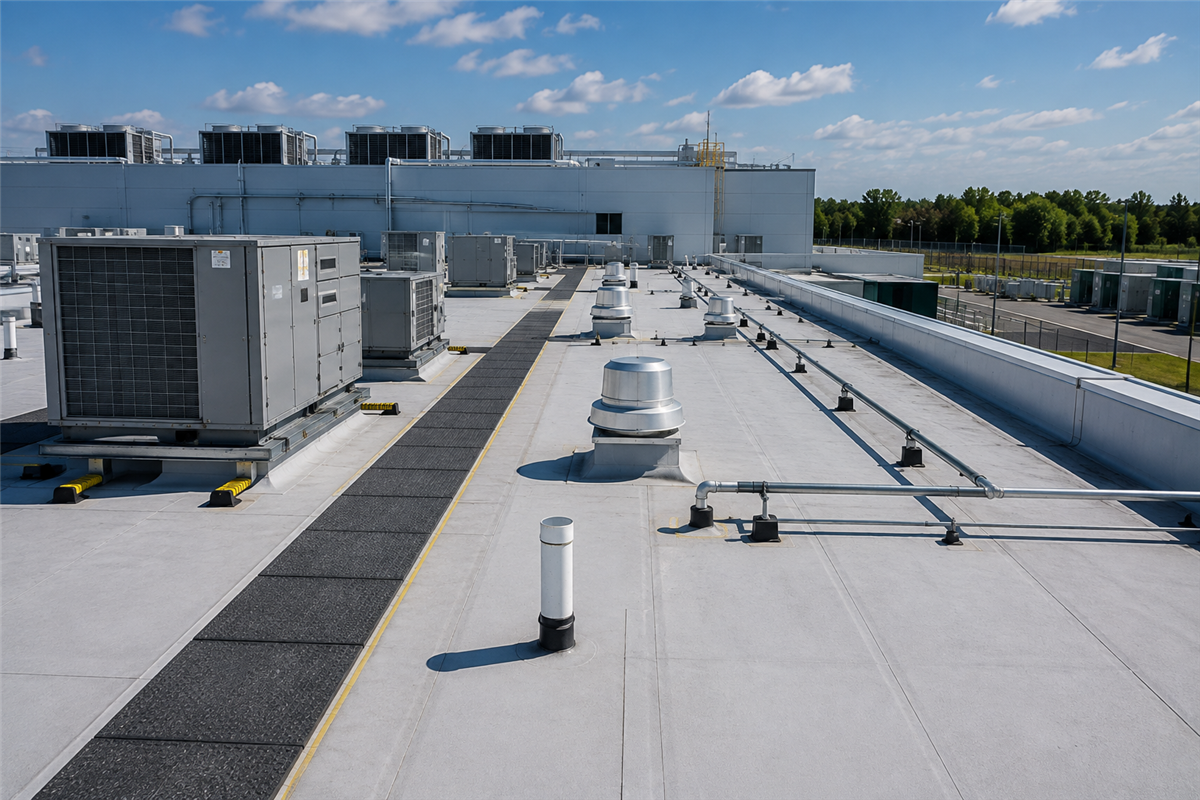
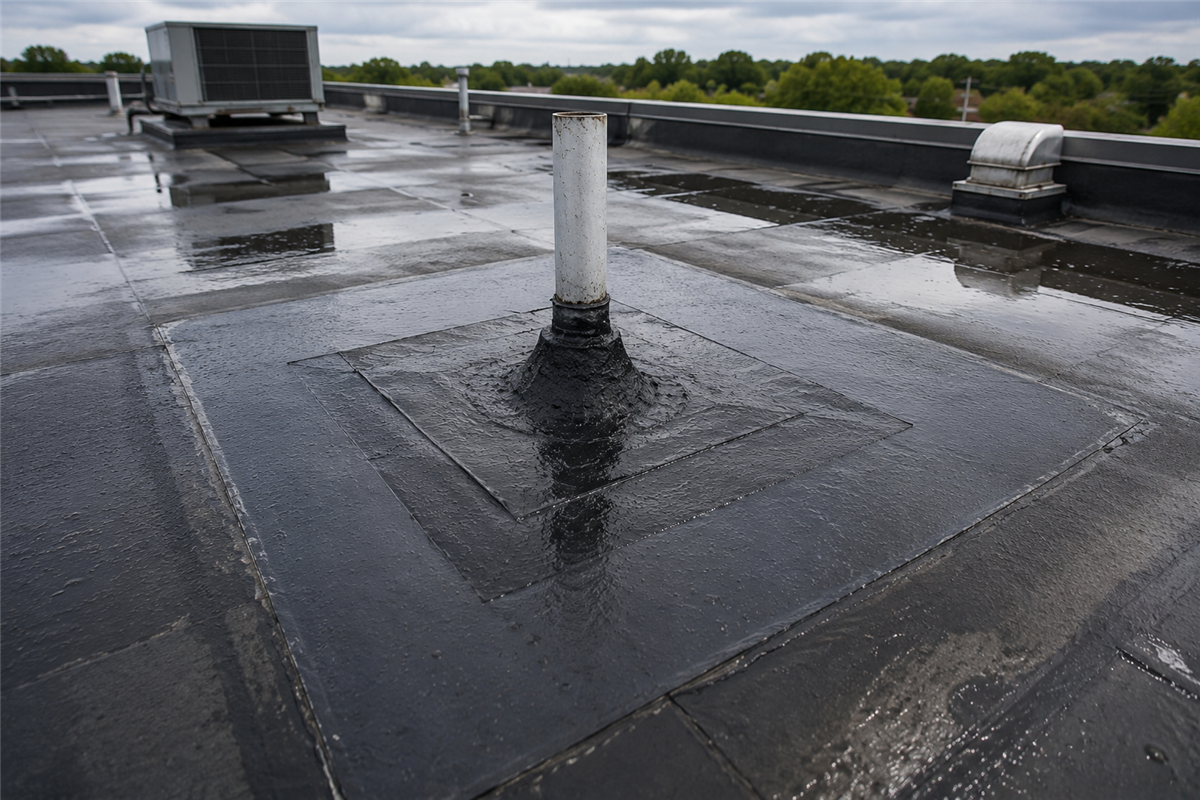
This is where most roof failures actually start. Flashing is the metal or membrane material that seals transitions, where the roof meets a wall, a curb, or a piece of equipment. Over time, thermal cycling (repeated heating and cooling) causes these materials to expand and contract, loosening fasteners and breaking adhesive bonds. A skilled inspector pulls and probes flashings at every penetration point: HVAC units, plumbing vents, skylights, conduit entries, and pitch pans. Seams between membrane sheets get the same level of scrutiny, since even a small separation can allow water to travel laterally beneath the surface for several feet before it shows up as a leak inside the building.
Membrane and Insulation Integrity
The membrane is your roof's primary weather barrier, so inspectors evaluate it for blistering, cracking, punctures, and UV degradation. Different systems show wear in different ways. TPO tends to develop chalking and weld failures, EPDM shrinks and pulls away from edges, and modified bitumen can crack at seam overlaps.
Insulation assessment is trickier because it sits beneath the membrane. Inspectors look for soft spots underfoot (a sign of saturated insulation), unusual surface depressions, and thermal anomalies. Some inspections include infrared scanning or core cuts to confirm moisture intrusion below the surface.
Here's a breakdown of the key components inspectors evaluate and why each one matters to the long-term performance of your roof:
| Component | What's Checked | Why It Matters |
| Membrane surface | Cracks, blisters, punctures, UV wear | Primary barrier against water entry |
| Flashings | Adhesion, fastener integrity, separation | Most common failure point on commercial roofs |
| Drainage | Blockages, ponding, flow direction | Prevents weight overload and membrane deterioration |
| Penetrations | Seals around HVAC, vents, pipes | High-risk entry points for moisture |
| Insulation | Saturation, compression, soft spots | Wet insulation loses R-value and adds structural load |
| Sealants and caulking | Cracking, peeling, gaps | Secondary defense that degrades faster than other materials |
The Inspection Report and Recommendations
The inspection itself is only half the value. The report is where you actually get your money's worth. A solid report includes annotated photographs of every deficiency, a prioritized list of recommended repairs with estimated costs, and an assessment of remaining service life. Some reports also flag warranty compliance issues, which is critical if your roofing system is still under manufacturer coverage. Without proper documentation, a warranty claim can be denied even when the defect clearly qualifies.
| A roof inspection without a detailed written report is like a doctor's visit without a diagnosis. The walkthrough identifies symptoms; the report tells you what to do about them. |
How Much Does a Commercial Roof Inspection Cost?
Now for the number everyone wants to see. Commercial roof inspection cost varies quite a bit depending on your building, but having realistic expectations keeps you from overpaying or underbuying.
Average Price Ranges by Roof Size
For a standard visual inspection of a single commercial building, most property owners in the DMV region pay between $300 and $2,500. Smaller buildings under 10,000 square feet typically fall in the $300 to $700 range. Mid-size properties between 10,000 and 50,000 square feet usually run $700 to $1,500. Larger facilities over 50,000 square feet can push past $2,000, particularly when the inspection involves infrared scanning, core sampling, or moisture detection equipment.
Multi-building portfolios get quoted differently. Volume pricing often brings the per-building cost down, but the total project scope goes up accordingly.
Key Factors That Affect Commercial Roof Inspection Cost
Square footage is the starting point, but it's far from the whole story. Here's a step-by-step way to evaluate what's actually driving the price on any proposal you receive:
- Confirm the roof's total area and access difficulty. A straightforward 20,000-square-foot flat roof on a single-story retail building costs less to inspect than a roof with multiple levels, parapets, or limited ladder access.
- Identify the roofing system type. TPO, EPDM, modified bitumen, and built-up roofing each have different failure patterns and inspection requirements. A contractor experienced across all single-ply membrane systems will know exactly where to look on each one.
- Ask about the number and type of penetrations. Roofs loaded with HVAC units, exhaust fans, and plumbing stacks take longer to inspect because each penetration is a potential failure point that needs individual attention.
- Check whether advanced diagnostics are included. Infrared thermography and core cuts add cost but reveal hidden moisture that a visual-only assessment will miss entirely.
- Review the scope of the deliverable. A detailed written report with annotated photos, repair cost estimates, and remaining service life projections costs more to produce than a verbal summary. But the report is where the real value lives.
Walking through these five points before signing anything helps you compare proposals on equal terms and avoid surprises on the invoice.
Is Your Commercial Roof a Managed Asset or a Future Emergency?
NV Roofing's complimentary inspection gives you a full condition report, capital risk assessment, and remaining service life estimate. A $2,400 value at no cost.
Claim My Free Inspection →
How NV Roofing's VAMP Turns Inspections Into Long-Term Savings
A one-off inspection gives you a snapshot. But a system built around those inspections is where the real financial return shows up. That's exactly what NV Roofing's Value Asset Management Program delivers: a structured approach that converts routine commercial roof inspection cost into measurable, long-term savings across your entire portfolio.
What the Value Asset Management Program Includes
VAMP works in three distinct phases. The first is a certified inspection that covers every critical low-slope roofing component: membrane condition, flashing and penetration integrity, drainage performance, moisture indicators, sheet metal, sealant systems, and warranty compliance. These inspections follow a set schedule (spring and fall at minimum, plus after any significant storm event). The second phase generates an objective Roof Condition Index score, which we'll cover below. The third feeds all findings into a centralized portfolio database designed for capital planning and budget forecasting.
NV Roofing's inspectors are certified and experienced across every major commercial system type, including TPO, EPDM, modified bitumen, built-up roofing, and coatings. That range of expertise matters because each system degrades differently. Missing a system-specific failure pattern defeats the entire purpose of the inspection.
Reactive Management vs. VAMP: Side-by-Side Comparison
Here's how a reactive approach stacks up against VAMP across the factors that most affect your bottom line:
| Factor | Reactive Approach | VAMP |
| Average roof lifespan | ~20 years | 40+ years |
| Repair cost per sq. ft. | 3–5x higher | Preventive-level pricing |
| Capital event frequency | Unpredictable | 60% fewer major events |
| Insurance positioning | No documented history | Full maintenance documentation |
| CapEx planning | Guesswork and surprises | Data-driven annual forecasts |
RCI Scoring and Capital Planning
Every VAMP inspection produces a numeric Roof Condition Index score, an objective and repeatable metric that removes subjectivity from roofing decisions. You can compare scores across buildings in a portfolio, track trends over time, and prioritize repairs based on actual field findings instead of age assumptions. That data feeds directly into annual CapEx forecasts, repair backlog estimates, and remaining service life projections. When you're presenting to a board or ownership group, RCI data gives you a defensible number rather than a gut feeling.
| VAMP turns your commercial roof inspection cost from a periodic expense into an investment that reduces total lifecycle roofing costs by 40 to 50%. |
The Free Spring Inspection Offer
For qualifying commercial properties in the DMV region, NV Roofing is currently offering a complimentary inspection valued at $2,400 as part of the VAMP Spring 2026 campaign. The assessment covers all critical roofing components and delivers a full written condition report, including a capital risk assessment and remaining service life estimate. There's no obligation attached. Properties up to 100,000 square feet qualify, and multi-building portfolios are welcome with volume pricing available for those who enroll afterward.
If you manage commercial properties in Northern Virginia, Maryland, or Washington, D.C. and want to see what a structured inspection actually looks like, contact us to schedule your complimentary assessment.
FAQs
How often should a commercial roof be professionally inspected?
Most commercial flat roofs last between 20 and 30 years depending on the membrane type, installation quality, and how consistently they are maintained. TPO and PVC systems tend to fall in the 20 to 25 year range, while well-maintained EPDM roofs can push closer to 30.
Does commercial roof inspection cost vary by roofing material?
Yes, different systems like TPO, EPDM, built-up roofing, and modified bitumen each have unique failure patterns that require different levels of expertise and time, which directly affects pricing.
Can a roof inspection help lower commercial property insurance premiums?
Maintaining documented inspection records demonstrates proactive maintenance to underwriters, which can improve your positioning during policy renewals and strengthen claims after storm damage.
What should I look for in a commercial roof inspection report to ensure I'm getting good value?
A quality report should include annotated photos of every deficiency, prioritized repair recommendations with estimated costs, remaining service life projections, and any warranty compliance concerns. If a report lacks these elements, the commercial roof inspection cost may not be justified.
Subscribe to NV Roofing's Blog