| TL;DR: Most commercial flat roof repair problems stem from membrane punctures, seam failures, drainage issues, and HVAC penetration leaks, all of which are preventable with regular inspections and prompt fixes. Choosing between a targeted repair, retrofit, or full replacement depends on the membrane's remaining life, insulation condition, and overall roof structure, and pairing any fix with documented maintenance is the most cost-effective long-term strategy. |
A small leak on a commercial flat roof costs almost nothing to fix early. Leave it six months, and you're looking at damaged inventory, displaced tenants, and a repair bill that's 10x higher. That's the pattern we see constantly. Membrane punctures, failed seams, ponding water, and deteriorating flashing-these problems don't announce themselves. They build quietly until something gives.
Most commercial flat roof repair problems are both preventable and fixable. You just need to catch them before they compound. This guide covers exactly how to do that-from diagnosing the root cause to deciding between a targeted repair, a retrofit, or a full replacement. You'll also learn what actually matters when searching for commercial flat roof repair near me, so you hire a contractor who solves problems instead of covering them up. Whether you manage one building or a portfolio across the DMV, this is the resource you need.
Common Problems That Lead to Commercial Flat Roof Repair
Flat roofs on commercial buildings don't fail randomly. They fail for specific, predictable reasons - and most of those reasons are completely preventable if you know what to look for. The difference between catching a problem early and dealing with a full-blown crisis often comes down to whether you recognized the warning signs in time. A $500 patch today can save you from a $50,000 disaster next year. Here are the four most common culprits behind commercial flat roof damage.
Membrane Punctures and Tears
Foot traffic causes more membrane damage than most building owners realize. Every time an HVAC technician walks across your TPO or EPDM membrane without designated walkway pads, something can go wrong - a dropped tool, a sharp piece of gravel ground underfoot, or just repeated compression along the same path. Storms add to the problem when wind-blown debris strikes the surface. What makes punctures so dangerous is how they behave once moisture gets through. A single small hole lets water into the insulation layer below, and from there, the damage spreads laterally in ways that are invisible from the surface. That stained ceiling tile inside your building? The affected area underneath the membrane is almost always much larger than the entry point suggests
Seam Failures and Flashing Deterioration
Seams - where two membrane sheets overlap - and flashing - the material that seals transitions around parapet walls, roof edges, and equipment curbs - are weak points by design. Thermal cycling puts constant stress on these areas. As temperatures swing from season to season, adhesive bonds and welds expand and contract repeatedly, weakening over time. Flashing that was perfectly installed ten years ago can gradually pull away from the substrate as caulking dries out and shrinks. Once seams or flashing fail, water has a direct, unobstructed path into the roof assembly, and the damage tends to accelerate quickly from there.
Drainage Issues and Ponding Water
Despite the name, a flat roof shouldn't actually be flat. It should have a slight slope directing water toward drains and scuppers. When those drains clog with debris or the roof deck deflects under load, water pools - and that's when problems start compounding. According to SFS USA's maintenance guide, standing water must be thoroughly investigated by a professional because it accelerates membrane degradation and adds significant structural weight. If water is still sitting on your roof more than 48 hours after the last rainfall, that's a clear signal your commercial flat roof repair needs attention - not next quarter, but now.
| Most commercial flat roof failures don't start as emergencies. They start as small, fixable problems that nobody noticed - or nobody prioritized - until the damage spread. |
HVAC Penetration Leaks
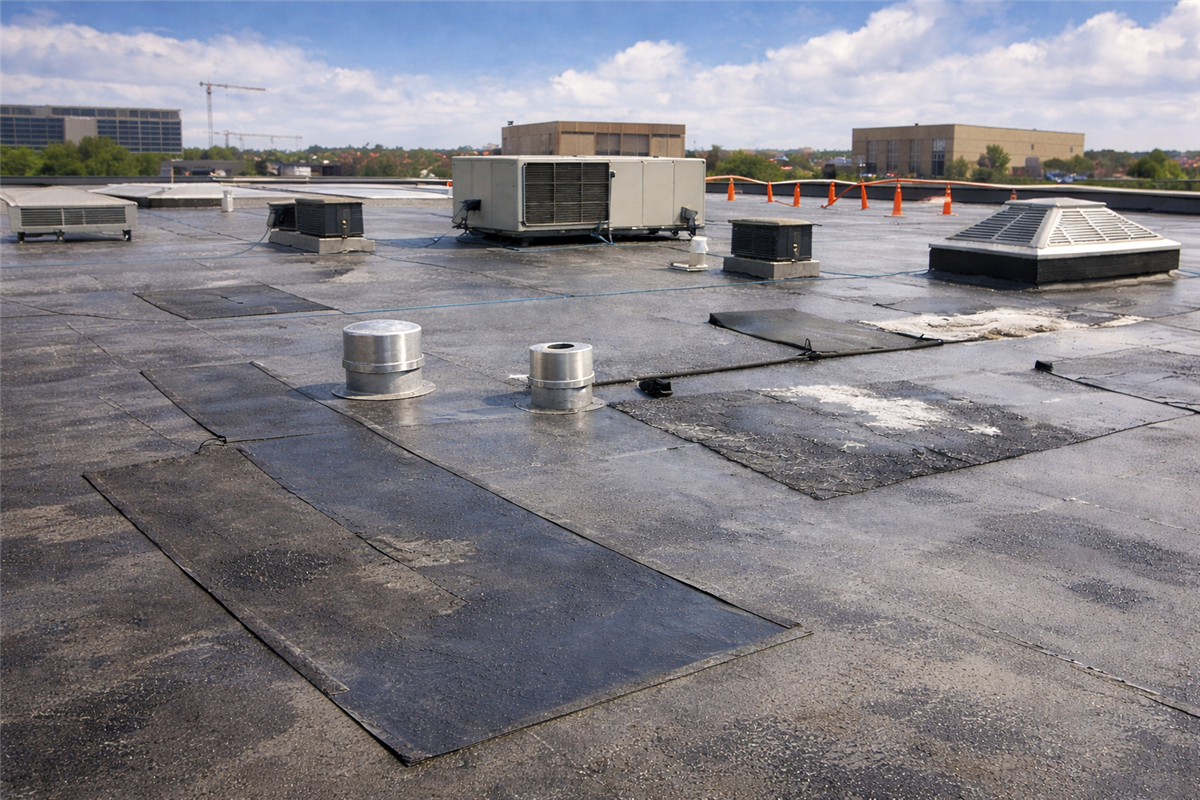
Commercial roofs tend to be crowded with equipment - condensers, exhaust fans, vent pipes, gas lines. Each unit requires a penetration through the membrane, sealed with flashing boots or field-fabricated curbs. These penetrations rank among the most leak-prone areas on any flat roof, and there are a couple of reasons why. First, vibration from running equipment loosens seals gradually, sometimes over months or years. Second, technicians servicing rooftop units can inadvertently damage the surrounding membrane without even realizing it. If your building has multiple rooftop units, think of each one as an independent failure point. Regular inspection around every penetration isn't optional - it's the only way to catch problems before they turn into leaks inside your building.
How to Repair a Commercial Flat Roof: Step-by-Step
Understanding what causes flat roof failures is one thing. Knowing how to actually fix them is something else entirely. The repair process itself isn't overly complex, but cutting corners or rushing through it is exactly how minor issues snowball into expensive, recurring problems. Here's the sequence that experienced roofing contractors follow - and what you should expect from anyone working on your building.
Step 1: Conduct a Thorough Roof Inspection
Every successful commercial flat roof repair begins with a real inspection - not a quick look from the parking lot, but a hands-and-knees walkthrough across the entire roof surface. The inspector should evaluate membrane condition, seam integrity, flashing at every penetration, drain functionality, and the overall state of the roof deck. Infrared moisture scans are particularly valuable at this stage because they expose trapped moisture beneath the membrane that you'd never spot with your eyes alone. If your contractor doesn't offer this capability, that's worth questioning. Bi-annual inspections (spring and fall) along with post-storm check-ups represent the industry standard.
Step 2: Identify the Damage Type and Scope
Not all roof damage looks the same, and not all of it calls for the same fix. A surface-level membrane tear is a completely different animal than widespread seam failure or saturated insulation sitting beneath the membrane. During this phase, the contractor should map out every issue uncovered during the inspection and determine whether each one is isolated or part of a larger, systemic pattern. A single puncture near an HVAC unit? That's likely localized. Multiple seam separations stretched across a wide section? That suggests an aging membrane or defects from the original installation. Getting this diagnosis right is what separates a repair that lasts from one that buys you a few months at best.
Step 3: Choose the Right Repair Method and Materials
Once you've pinpointed the problem, the repair approach and materials need to match both the type of damage and your existing roof system. Here's a breakdown of the most common methods, what they're suited for, and where they fall short:
Commercial Flat Roof Repair Methods Compared
| Repair Method | Best For | Limitations |
| Membrane patch (same material) | Isolated punctures, small tears | Won't fix underlying insulation damage |
| Seam re-welding (TPO/PVC) | Localized seam separations | Requires heat-welding equipment and training |
| Flashing replacement | Deteriorated transitions at walls, curbs, edges | Must match existing system to maintain warranty |
| Roof coating application | Widespread surface wear without structural issues | Not a substitute for membrane replacement on failing roofs |
The bottom line here: always use materials that are compatible with your existing membrane. Mixing systems - like slapping a TPO patch over EPDM - creates adhesion failures and will almost certainly void your manufacturer warranty.
Step 4: Execute the Repair
The quality of the repair comes down to the crew performing the work. The damaged area must be cleaned and dried completely before any adhesive, sealant, or heat weld touches the surface. Moisture trapped beneath a patch is a guaranteed path to failure within months. For seam repairs on TPO or PVC roofs, weld temperature and travel speed need to be dialed in precisely - too hot and the membrane burns through, too cold and the bond won't hold under stress. Flashing replacements should extend well past the failed section to prevent the same problem from creeping back at the edges.
Step 5: Document and Schedule Ongoing Maintenance
This is the step most building owners skip entirely, and it's the one that matters most for long-term cost control. Every repair should be photographed, logged with the date and materials used, and linked to a recurring maintenance schedule. That documentation pulls double duty - it provides a clear paper trail for warranty claims and helps your roofing partner identify patterns that keep showing up. If the same flashing detail fails every 18 months, the underlying design needs to change, not just the patch material.
| A repair without documentation is just a temporary fix. A repair with documentation becomes part of a long-term asset management strategy. |
Repair vs. Retrofit vs. Replace: How to Decide
This is the decision that trips up most property managers. You've identified the damage, you know the roof has problems, but now comes the hard part - do you patch it, coat over it, or tear the whole thing off and start fresh? Each option comes with different costs, timelines, and long-term consequences. Get this wrong and you'll either overspend on a problem that didn't warrant it or underspend on one that did.
When a Repair Is All You Need
A targeted commercial flat roof repair makes sense when the damage is isolated, the membrane still has useful life left, and the insulation underneath is dry. We're talking about a single puncture near a rooftop unit, a short section of failed seam, or flashing that's pulled away at one penetration point. If your last inspection showed the rest of the roof in solid shape, spending on a full replacement would be throwing money away. Repairs typically cost a fraction of other options and can be wrapped up in hours rather than days - meaning minimal disruption to your tenants or operations.
The key qualifier here: the roof system itself must still be structurally sound. A repair on a membrane that's already past its expected service life is just buying time - and not much of it.
When a Retrofit Makes More Financial Sense
A retrofit - sometimes called a roof recovery or re-cover - involves installing a new membrane or coating system directly over the existing one. It skips the costly tear-off step, which saves on both labor and disposal. Addressing flat roof issues early through repair and restoration services prevents further damage, lowers long-term maintenance costs, and preserves property value. A retrofit fits that logic perfectly when the existing deck and insulation are still in good condition but the membrane has reached the end of its useful life across a wide area.
Here's a step-by-step decision process to help you figure out whether a retrofit is the right call for your building:
- Check local building codes: most jurisdictions allow only one recover layer over the original membrane. If your roof already has two layers, a retrofit is off the table.
- Core sample the existing roof: a contractor cuts small sections to verify whether the insulation beneath is dry and structurally intact. Wet insulation means a retrofit will just trap moisture underneath.
- Evaluate the deck condition: if the steel or concrete deck shows signs of corrosion or deflection, layering a new membrane on top won't address the root problem.
- Compare the cost against your remaining building plans: if you plan to hold the property for another 15+ years, a retrofit with a high-quality coating or membrane can deliver strong ROI without the expense of full replacement.
Following these steps keeps your decision grounded in data rather than guesswork - and it protects you from sinking money into a retrofit that fails before it should.
When Full Replacement Is the Only Option
Sometimes there's no way around it. If moisture has saturated the insulation, if the deck itself is compromised, or if the roof has already been recovered once and code won't allow another layer, full replacement is the path forward. The same applies when recurring repairs on the same roof start adding up to a significant percentage of what a new system would cost. At that point, you're not saving money - you're just spreading the expense out inefficiently.
Full replacement also makes sense when you want to upgrade to a higher-performing system, improve energy efficiency, or reset your warranty clock entirely.
| The cheapest option isn't always the most cost-effective one. A full replacement that lasts 25 years often beats a cycle of repairs and retrofits that adds up to the same total - with far more headaches along the way. |
Finding the Right Commercial Flat Roof Repair Near Me
Knowing how to repair a commercial flat roof is only half the battle. The other half? Finding a contractor who can actually get the job done right - and stand behind the work long after their crew packs up. Not every roofing company is built for commercial-scale projects, and hiring the wrong one can end up costing you significantly more than the original damage ever would.
What to Look for in a Commercial Roofing Partner
When you search for commercial flat roof repair near me, you'll get a long list of results - and most of those websites sound identical. So how do you tell the real operators apart from the ones who'll slap a patch on your roof and vanish? It comes down to a few key differentiators that separate reliable commercial partners from everyone else.
Here's a breakdown of the qualities worth evaluating before you sign anything:
Key Qualities to Evaluate in a Commercial Roofing Contractor
| Quality | Why It Matters | Red Flag If Missing |
| Documented commercial experience | Commercial roofs involve different systems, codes, and stakes than residential work | Portfolio only shows single-family homes |
| Manufacturer certifications | Ensures warranty-compliant installation and access to extended coverage | Can't name specific certifications when asked |
| Maintenance program offerings | Signals a long-term partnership mindset rather than one-off transactional work | Only offers repair and replacement, no ongoing service |
| Emergency response capability | Storm damage and sudden leaks can't wait for a scheduling queue | No after-hours contact or unclear response timelines |
| Clear communication and documentation | You need inspection reports, repair logs, and photo documentation for asset management | Verbal-only updates with no written records |
How NV Roofing Supports Property Managers and Building Owners
If you manage properties in Northern Virginia, Maryland, or Washington, D.C., NV Roofing's Commercial Division was built around the exact challenges you face every day. With over 60 years of experience as a family-owned company, NV Roofing handles commercial flat roof repair across office buildings, apartment complexes, retail centers, and industrial facilities - all engineered for durability with minimal disruption to your tenants and daily operations.
What sets NV Roofing apart goes beyond individual repairs. Our NV Priority Plus maintenance program takes a structured approach to roof asset management, including scheduled inspections, priority service, and documented repair tracking. That's the kind of program that extends roof life and keeps your total cost of ownership low over the long haul. Their commercial services also cover siding, windows, heavy-duty gutter and drainage systems, and rapid-response storm damage restoration when situations demand immediate attention.
Whether you need a targeted commercial flat roof repair or a long-term maintenance partnership, contact us to discuss your property's needs and get a straightforward assessment.
FAQs
How long does a commercial flat roof typically last before needing replacement?
Most commercial flat roofs last between 20 and 30 years depending on the membrane type, installation quality, and how consistently they are maintained. TPO and PVC systems tend to fall in the 20 to 25 year range, while well-maintained EPDM roofs can push closer to 30.
Can I handle commercial flat roof repair without hiring a professional?
DIY repairs on commercial roofs are strongly discouraged because improper patching or material mismatches can void manufacturer warranties and lead to hidden moisture damage that worsens over time. A licensed commercial roofing contractor has the equipment, training, and diagnostic tools like infrared scanning to ensure the repair actually holds.
What is the best material for patching a flat roof membrane?
The best patch material is always the same type as your existing membrane, whether that is TPO, PVC, or EPDM. Using mismatched materials creates adhesion problems and almost always leads to premature failure at the repair site.
How often should a commercial flat roof be inspected to prevent costly damage?
Industry best practice calls for professional inspections twice a year, typically in spring and fall, along with additional checks after any significant storm event. Sticking to this schedule is one of the most effective ways to catch small issues before they escalate into major commercial flat roof repair projects.
Why do so many commercial buildings have flat roofs instead of sloped ones?
Flat roofs maximize usable interior space, cost less per square foot to install, and provide a practical platform for HVAC equipment, solar panels, and other rooftop systems. They also simplify construction on large-footprint buildings like warehouses and office complexes where pitched framing would be impractical and significantly more expensive.
Subscribe to NV Roofing's Blog